




MUMBAI
:
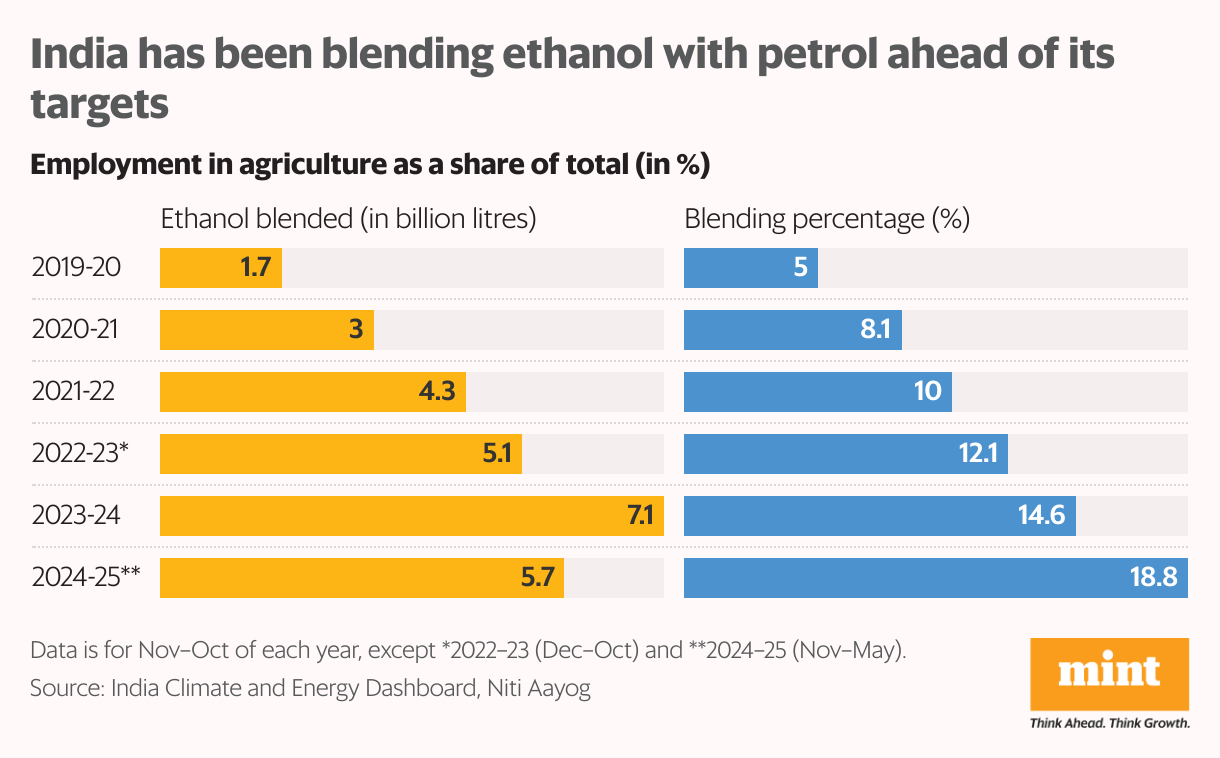
India achieved its target of blending up to 20% ethanol into petrol in March 2025—five years ahead of the 2030 deadline. Now, the government has grown more ambitious: It wants to blend more ethanol into petrol.
But why is India using more ethanol-blended petrol like E20? How does it affect our vehicles? Most importantly, can it reduce the harm caused by fossil fuels? Mint explains:
Why is India blending ethanol with petrol?
Primarily, to reduce our import bill and emissions.
In 2003, India started a pilot programme to blend ethanol—a byproduct of sugarcane—into petrol to reduce carbon emissions from the fuel’s use. By 2019, the Ethanol Blended Petrol (EBP) Programme was extended to all of India (except the Andaman and Nicobar Islands and Lakshadweep).
The ethanol blending helps the country reduce its crude oil imports and bring down its foreign-exchange outflow.
Where are we on our ethanol blending programme?
As of 2025, all commercially available petrol in India is E20, meaning 20% of it is blended with ethanol. We reached this target five years earlier than the planned 2030 deadline. Now, the government is planning to hike blending targets to 27% by 2030 and sell E27 petrol by 2030, reported The Times of India on 17 July.

The ministry of petroleum and natural gas (MoPNG) denied the report, saying it had not made a decision on higher ethanol blending yet.
However, in June, the ministry of road transport published a notification proposing changes in the Central Motor Vehicle Rules, 1989, that will allow automakers to manufacture ‘flex fuel’ vehicles. These can run on E85—petrol containing 85% ethanol.
Has ethanol blending delivered on its objectives?
Yes, at least according to the government. India’s greenhouse gas emissions reduced by 19.2 million tonnes between 2014 and July 2021, showed the latest ministry of petroleum and natural gas estimates. The ministry said the country also saved over ₹26,000 crore in foreign exchange by cutting its reliance on crude oil imports during the period.
So, what’s the fuss about E20 and higher ethanol-blended petrol?
Consumers aren’t enthused about buying petrol blended with ethanol for a number of reasons.
First, burning ethanol produces less energy than petrol, so E20 and other blends affect car mileage. This means car owners are forced to buy more petrol to travel the same distance.
Second, despite blending ethanol with petrol and saving on import costs, the government has not reduced petrol prices; oil marketing companies continue to retail the fuel at above ₹100 per litre in most major cities.
Third, engines of older vehicles may not be compatible with E20 and newer blends that the government may introduce next.
For customers, ethanol-blended petrol may be reducing the lives of their vehicles with no discernible savings in fuel costs.
But isn’t it worth the reduced emissions?
Perhaps. Environmentalists say there are second- and third-order effects to producing ethanol-blended petrol in India. As farmers grow more sugarcane to convert to ethanol and sell to the government, land and water resources in delicate areas come under pressure, adding to environmental stress.
Instead, the government should focus on turning biomass from existing activities—such as wood chips and crop residue—to make more ethanol. In 2021, the Niti Aayog said a “relatively small” part of ethanol procurement came from non-sugar sources.
Besides, vehicle makers will need to invest in upgrading the engines of their newer cars so that they can run on petrol blended with more ethanol. Energy experts say the government must also determine how to promote electric vehicles alongside ethanol-blended fuel-run vehicles.
Are carmakers ready for this upgrade?
Perhaps. In March, the Society of Indian Automobile Manufacturers told the MoPNG that carmakers could reduce the loss of engine efficiency due to E20 petrol with some modifications in engine hardware and tuning. At any rate, the ministry said that E20 had only a “marginal reduction” in fuel efficiency of cars made for E10 and calibrated for E20.
Manufacturers are getting ready for newer fuel norms. At Bharat Mobility Global Expo 2025, leading carmakers, including Maruti Suzuki, Hyundai, Tata Motors, and Mahindra & Mahindra, showed flex-fuel cars that can run on E85 and higher grades of ethanol-blended petrol.