




The conversation took place in Krishna Kalyanpur village in Panna district, about an hour and a half away from the medieval Khajuraho temples, a Unesco World Heritage Site in Madhya Pradesh famous for its intricate sandstone carvings and explicit sexual imagery.
Panna is also home to a tiger reserve, spread over 1,500 sq. km, as wildlife enthusiasts and Instagram scrollers know.
What is less known though is that Panna is the only location in India where diamonds continue to be mined.
But, despite its ancient glory and mineral deposits (which also include limestone, used to produce cement), Panna is among the poorest districts in India; it belongs to the back-of-beyond Bundelkhand region, a hub of extreme poverty and distress migration straddling parts of Uttar Pradesh and Madhya Pradesh.
This place is a magnet for troubled souls. You wouldn’t be here if life was smooth. — Ram Kumar Gupta
Diamonds are mined through both mechanized and artisanal methods. Gupta belongs to the lot of artisanal miners and operates a micro, open-cast mine. Before taking up this backbreaking work last November, he ran a transport business from the neighbouring Chhatarpur district. Gupta’s six trucks plied across states. A string of accidents and mishaps, however, led to a bankruptcy and left him with debt of over ₹40 lakh.
There was only one way out.
If Gupta could find a diamond in the shallow mines of Panna, his financial troubles would vanish overnight. In 2025, a few did land a fortune. Among them was a farmer from Panna, Swamidin Pal, who found a 32-carat diamond in his field. The piece was auctioned for ₹2.21 crore.
Half a volleyball court
Any Indian citizen can try their luck in Panna. From the diamond office, one can lease an 8m by 8m parcel of land, less than half of a volleyball court in size, for a nominal fee of ₹200 for a year.
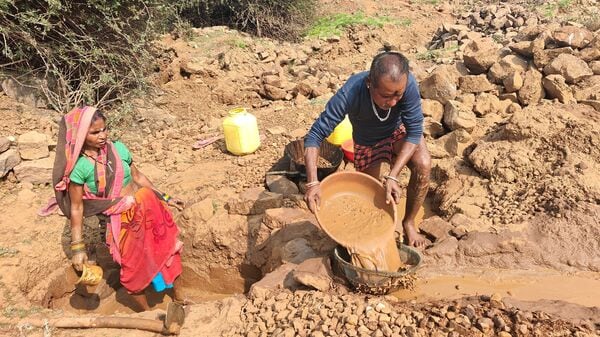
Then begins the grind. Using rudimentary hand tools, one has to remove the top soil and keep digging—the deeper the better. Usually, these man-made craters are between 8ft and 10ft deep. Some hire an earthmover to do the job and also use rented drilling machines to blast large stones. The smaller chunks of sandstone are broken by hand, using hammers.
The unearthed layers of gravel nestled between rocks are collected carefully. These are sieved and washed to remove soil particles. The gravel is laid out on an even and clean surface to dry. Then one has to carefully look through the gravel to find any sparkling piece of stone that could be a diamond.
It’s physically draining work and years of effort often yield absolutely nothing. People like Gupta will end up spending ₹1-1.5 lakh in less than a year. This includes the rent of basic accommodation in a nearby village ( ₹2,500 per month) and food expenses. Some deploy hired labour for the job, but the poorest often stay on site in makeshift tents. These flimsy structures look as if they will be blown away by a heavy gust of wind.
When desperation meets greed
Some give up within days, particularly those who are drawn to Panna after seeing YouTube reels of someone striking it big,” Gupta said. “I will be here till December. By the grace of god, I might find a piece.”
The plot where Gupta is mining his tiny patch is part of a land parcel of less than 100 acres, next to a water body. Among others exploring this patch, which resembles a battle zone with craters and giant chunks of unearthed sandstones, is a motley crowd: a former carpenter who left his vocation after an accident damaged his fingers and left him neck deep in debt; a frail old couple in their 60s digging in the hope of finding a diamond that will pay for the construction of a temple back home; a local sanitation worker who has been trying his luck for decades, without success.
In a way, Panna evokes a microcosm of emotions: desire bordering on greed and an unwavering faith that divine providence can turn one’s life around.

View Full Image
“I haven’t found one (diamond) in more than 20 years. But today is a new day. Anything can happen,” said a spirited Santosh Harijan, a local sanitation worker. He’s been at this job since he was a child. The price of his obsession? At 48 years, Harijan’s feet resemble the dark yellow of the soil he turns. He could not afford to educate his children. They are now casual workers surviving on day wages. His daughter is waiting to be married. Harijan hopes a diamond will be his redemption. But when one considers the costs he incurs every season plus the foregone wages, his entire life appears to be a gamble, chasing a mirage.
‘Andha kaam’
Natural diamonds were formed deep within the Earth’s mantle under extreme heat and pressure, which force carbon atoms to bond together tightly, creating the hardest natural material known to mankind. Diamonds, which were formed between one and three billion years ago, were transported to the surface of the earth by violent volcanic eruptions, via what is known as kimberlite pipes. These carrot-shaped pipes, which transport magma, are the primary source of natural diamonds.
As these kimberlite pipes were weathered and eroded over millions of years, the deposits were carried downstream by rivers. The floodplains and riverbeds adjoining the kimberlite deposits form a secondary source of diamonds, which are mined by artisanal explorers.
Some Panna residents also mine their own farmland and use hired labour, bringing in business partners who share the costs of mining, in exchange for a share of the diamond’s value. Puran Pal, for instance, found a 7-carat piece in 2024 on his farm plot in Sarkoha village.

View Full Image
The piece went for ₹16 lakh at auction. But after paying his seven partners and accounting for the hired labour, Pal was left with almost nothing.
“They work the earth knowing “ye kaam bilkul andha hai”, like trying to find a needle in a haystack, blindfolded.
Besides, the likelihood of finding a piece in these secondary deposits is lower when compared to kimberlite sources. The odds are stacked against artisanal miners like Gupta and Pal. They work the earth knowing “ye kaam bilkul andha hai,” like trying to find a needle in a haystack, blindfolded.
Diamond-officer-in-chief
When a leaseholder finds a piece, it is deposited in the office of Ravi Patel, the district mining officer in Panna. Every year around 500 leases are issued to artisanal miners, said Patel.
The proceeds from the auction are deposited in the finder’s bank account, after deducting 11.5% royalty and another 1% tax deducted at source.
Patel said that annually, between 300-500 carats of diamonds from Panna are deposited with the state government, which earns less than ₹1.5 crore in royalties. He agrees that the chances of finding a diamond in secondary sources such as riverbeds is extremely low. The entire artisanal mining industry, therefore, is a loss-making venture, particularly for destitute miners who stake years of their lives and earnings in the hope of striking it rich.

View Full Image
Then, why are licences still being issued? If artisanal mining with legal leases is barred, explains Patel, the risk is that all activities will go underground. This will lead to a black market and illegal trade with unaccounted cash.
One cannot rule out violence. “This is why we encourage miners to deposit diamonds at the mining office and not sell in the black market,” Patel said.
Yet, an estimated 300-500 carats a day are sold in the illegal market. These come from unauthorized mines operating in Panna’s forest areas or from riverbeds where mining licences are not issued.
The government’s mine
Currently, the only mechanized diamond mine in India is operated by the central government-controlled NMDC Ltd in Majhgawan, about 15km from Panna town. The mine, situated in the buffer zone of the tiger reserve, has been sourcing diamonds since the early 1970s from the kimberlite primary deposits.
This is the irony of Panna: mechanized mining aided by advanced tools is an unviable venture, yet artisanal miners are allowed to work shallow mines with hand tools.
The project has an annual production capacity of 84,000 carats. However, except for a few years, the diamond project has never been commercially viable since its inception, said a senior NMDC official, who did not want to be named. Still, the project continues, subsidized by the public sector undertaking’s profitable iron ore mining operations in other locations.
This is the irony of Panna: mechanized mining aided by advanced tools is an unviable venture, yet artisanal miners are allowed to work shallow mines with hand tools.
Interestingly, the only viable project never took off. In 2017, global mining giant Rio Tinto abandoned a diamond mining project in Bunder, in neighbouring Chhatarpur district, following long years of delay in getting environment clearance. The Bunder kimberlite deposits were estimated to contain over 27 million carats, the largest in India.
Land of the Koh-i-Noor
The global trade in diamonds originated from India, likely as early as the 4th century BC, according to some historians. Until the 1700s, India was the only source after which Brazil emerged as a supplier.
The famous Koh-i-Noor diamond, weighing over 105 carats, is believed to have come from the Golconda mines in present day Andhra Pradesh. It passed hands multiple times, from the peacock throne of Mughal Emperor Shah Jahan to the crown worn by British queens where it remains now.
The more modern history of the diamond trade has its epicentre away from India. In 1866, the discovery of diamond deposits in Kimberley, South Africa, made it the leading global supplier, displacing limited supplies from India and Brazil. By 1900, De Beers’ South African mines controlled an estimated 90% of the world market.
The later entrants, which dominate the market now, are mines in Botswana, Russia (facing economic sanctions due to the Ukraine war), Canada and the Democratic Republic of Congo.
India is a negligible supplier of diamonds today but processes—cuts and polishes—over 90% of the world’s rough diamonds.
Blood vs sweat diamonds
In the 1990s, the United Nations coined the term ‘blood diamonds’ to describe diamonds that had fuelled and funded brutal civil wars in diamond-rich areas in Angola, Congo and Sierra Leone.
The extremely limited supplies from Panna are not products of conflict, but can be termed ‘sweat diamonds’ mined by desperate people mired in debt and extreme poverty. If anything, these artisanal miners have one less reason to continue—rough diamond prices had crashed 40% by 2025 from the highs of 2021-22, due to competition from cheaper lab grown diamonds and a pile-up of natural diamond inventory with sellers.
 ₹30 lakh.” title=”Rajendra Vishwakarma, a former carpenter, is hopeful that a diamond will help him repay a debt of over ₹30 lakh.”>
View Full Image
However, word of these changing industry dynamics is yet to reach the riverbed of Runj in Panna, where a medium-scale dam for irrigation is under construction.
On a wintry January morning, the riverbed is a hub of frenetic activity. On the edge, two friends cook breakfast over firewood, before starting the day’s work. They are daily wagers from Rajasthan and Telangana, who befriended each other in this elusive quest.
A little further away, Shankar Adivasi, 27, who lost his farm and home to the Runj dam, has already begun working the riverbed. He has been at it for six years, without any success. His four children, all less than five years of age and born in quick succession, are yet to attend school. The family lives in a flimsy tent next to the riverbed.
Through the day, Shankar keeps digging, removing large chunks of stone and gravel. Every night the pit fills with water from the riverbed. So, he has to begin his day by removing the accumulated water with a plastic bucket—a Sisyphean task that he repeats every day.

View Full Image
How long will he continue to do this? Will he ever find a diamond? Like many other fortune hunters of Panna, Shankar has a cryptic response: “There’s a divine debt all of us owe. When mine is repaid with hard labour, I will find one.”