




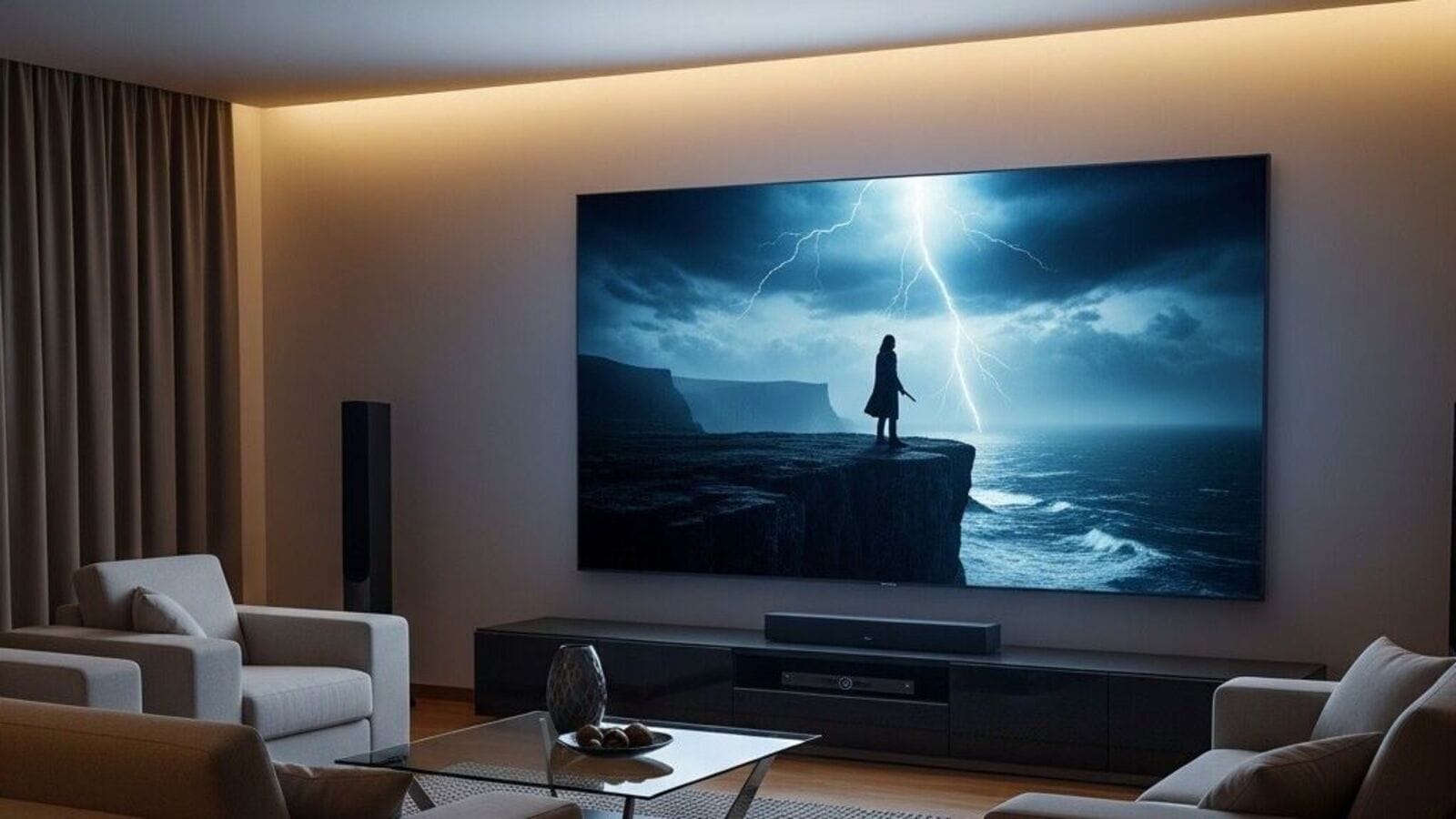
In conference rooms and at global festivals, digital evangelists point to mobile video and connected screens as the future, dismissing television as a relic of the past. But the numbers, and the marketers spending the money, tell a very different story.
India has about 210 million TV households, which means a 70% penetration among the country’s 300 million homes. As many as 100 million households have yet to buy their first set. Indians are not just watching; they’re watching more. Rural audiences now spend 44 minutes more per week on TV than two years ago. Gen Z, supposedly the “Netflix generation”, is clocking in 51 minutes more weekly viewing. Even metros spend close to four hours daily in front of the television.
So, if audiences aren’t abandoning the medium, why are advertisers so eager to do?
Digital cannot buy trust
For Ragini Hariharan, chief marketing officer, Himalaya Wellness Company, the logic is simple. “For brands who have to reach deeper to the consumer, TV continues to be the most efficient medium. The cost of reaching that scale of consumers through digital would be too high. When I want to drive penetration for a mass product like face wash, I need TV,” she said.
Hariharan draws from her early work on detergent powder Tide Naturals: “The risk for a rural consumer is way higher than for an urban consumer. In cities, I can try another product the next time. In villages, trust plays a much bigger role. And trust comes from seeing a brand everywhere. TV builds that scale.”
Her caution: TV’s role has shifted from 24×7 presence to high-impact bursts. “IPL is the obvious example, but regional properties like Bigg Boss Tamil have delivered massive spikes for us. The stickiness matters, audiences wait for the next season, and the brand travels with it,” she said.
Broadcasters smell blood in digital’s hype
Broadcasters are no longer defensive about television’s future. Mahesh Shetty, head of revenue—entertainment, JioStar, said TV’s mass appeal remains unrivalled: “With 900 million viewers, 190 million TV homes and 46 trillion minutes of viewing annually, television remains the country’s default entertainment platform. Its biggest strength lies in collective family viewing. 88% of TV consumption is co-viewing across genders, age groups and NCCS (new consumer classification system), making it uniquely powerful for brand storytelling at scale.”
Shetty argued that free TV and pay TV together give advertisers the most inclusive reach. “Free TV, with Star Utsav at the forefront, extends access to millions in rural and value-conscious markets, while Pay TV delivers premium storytelling and appointment viewing for urban and affluent audiences. Together, they make television the most inclusive medium, unmatched in reach and cultural resonance,” he said.
Ad rates, he insisted, are holding firm despite digital’s expansion. “Television’s value proposition is anchored in quality audiences at scale—brand-safe, trusted, collective viewing environments. Advertisers recognise that TV delivers impact they can’t substitute. That’s why the most effective campaigns still begin with TV’s mass foundation, then get amplified digitally,” Shetty added.
Rituparna Dasgupta, executive vice-president – network research & planning, ZEE Entertainment Enterprises Ltd, framed TV as both aspirational and emotional. “We are optimistic about the 90–100 million unpenetrated households that will buy their first TV sets in the near future. Rural youth are driving viewership growth, but urban India still spends almost four hours daily on TV. Women in our research describe television as sakhi and sarathi (a companion and guide). In fact, for a typical Indian household, prime time is still family time. Television remains the last common room,” she said.
Dasgupta also stressed TV’s role as a synergy multiplier. “Multiple studies show TV amplifies the performance of every other medium. A neuroscience study we commissioned proved that TV delivers the highest attention and impact compared to other mediums. While TV brings the scale and impact, digital adds incremental reach and interactivity,” she said.
Agencies hedge, but admit TV holds weight
Agencies, caught between client obsession with ROI (return on investment) and the ground reality of reach, take a more pragmatic view. Lalatendu Das, chief executive officer, Publicis Media South Asia, said TV still holds relevance for brands with large offline presence, especially FMCG and live sports. “Live cricket continues to deliver universal reach with strong attention metrics. Beyond sports, genres like GEC, news and regional content have their own fandom. But if we look at linear TV alone, absolute reach is declining in urban centres, and in some cases we are already seeing digital-only plans deliver sharper outcomes,” he said.
Das acknowledged that the planning mindset has shifted. “Gone are the days when planners took TV as the anchor and added digital for reach. Today, planners pick the most optimal medium for the brand objective. Linear TV will remain part of the mix, but it must innovate— whether through interactive content, improved targeting or smarter measurement—to stay relevant.”
Measurement remains the weak link
For Partho Dasgupta, managing partner, Thoth Advisors, and former chief executive officer, BARC India, the problem is structural. “The term ‘TV
television’ is outdated. Broadcasters should see themselves as content companies, delivering stories across devices. Measurement is the bigger issue—BARC has fallen behind in adopting deterministic models. It needs a reset, from governance to technology, to capture all screens and pipes,” he said.
Yet, he conceded that the core truth remains unchanged: “If one needs to build a brand that reaches mass, you cannot do it without TV. Performance marketing can deliver sales, but the moment you reduce budgets the numbers dip. For long-term trust and equity, TV is still indispensable.”
The real fight: attention, not existence
If anything, the battle is not TV versus digital, but TV with digital. Neuroscience and Brand Lift studies suggest television commands higher attention and emotional resonance than user-generated platforms, while digital offers precision and interactivity. Advertisers are realising that one without the other is a false choice.
As broadcasters invest in connected TV and screen-agnostic planning, they are reframing the debate. Shetty at JioStar called it a “screen-agnostic approach,” adding: “Linear and streaming come together on one ecosystem, giving advertisers holistic planning options. Far from fragmenting the market, connected TV can unify it.”
The paradox is clear. TV penetration is still rising. Time spent is increasing across rural and urban cohorts. Gen Z is watching more, not less. And yet, in marketing conversations, TV is too often framed as a legacy medium on borrowed time. Why?
Part of the answer lies in perception. Digital feels new, sexy, and measurable. TV feels old, unwieldy, and traditional. But as advertisers redraw budgets, one truth is hard to escape: for mass brand building, television isn’t dying. It’s still doing the heavy lifting.