



For Barrett, who co-founded the brand with her Irish husband Robert Barrett at Rebel City Distillery, the listing marked a shift from “interesting newcomer” to something closer to mainstream. “We weren’t sure how Irish consumers would respond to South Asian flavour profiles,” she said. “But they embraced it.”
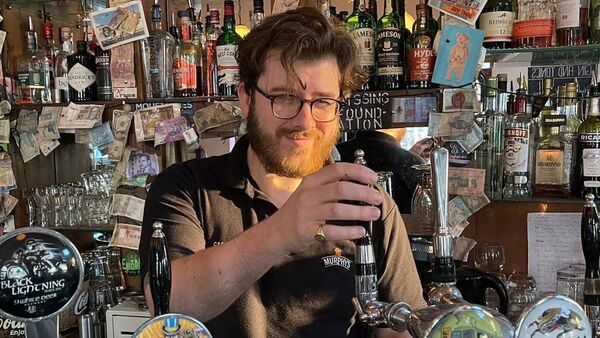
Dai Bowes can attest to that. The bar manager at the Friary, a pub in Cork, Ireland, first became aware of Maharani Gin through local media coverage during the covid lockdown.
Soon after, the Friary contacted the Barretts, tasted the gin, and decided to list it. Bowes says Maharani is “one of the few gins that I would drink just on its own with a bit of ice,” noting that it is very smooth compared to much of the gin market. He likes the “beautiful bottle,” which “looks very good on a shelf,” and says the Indian influence became clearer after he learned more about the botanicals and flavour profile.
But, Bowes notes that drinkers who only prefer traditional brands such as Gordon’s or Bombay Sapphire may not gravitate toward Maharani Gin.

View Full Image
Like the Barretts, Indian-origin founders across North America and Europe are building alcohol brands inspired by Indian flavours and food cultures, but brewed or distilled outside India. These are not imports. They are locally made products, designed for restaurant tables, cocktail menus, duty-free stores and retail shelves.
Covid compulsions
In Portland, Maine, brothers Vanit and Sumit Sharma grew up observing their parents’ Indian restaurants, watching diners order Kingfisher beer with curry. During the pandemic, those imports became erratic. Containers arrived late—or not at all. Restaurants substituted whatever they could get.
Rather than wait for normalcy, the Sharmas built locally. Working with brewmaster Alan Pugsley, they developed Rupee Beer—a low-carbonation range brewed with ingredients such as basmati rice, designed to pair with Indian and spicy cuisine. “If your mouth is on fire,” Vanit Sharma said, “you don’t want a gassy beer—carbonated beers enhance your tongue’s pain receptors when on fire from a spicy Indian curry.”

View Full Image
On Canada’s west coast, Vivek Taneja, co-founder of Baadshah Beer, saw the same gaps in the province of British Columbia (BC). “Indian beer imports were inconsistent even before covid,” he said. “During covid, they practically vanished.” Baadshah launched in October 2022 and now pours on tap in close to 100 Indian restaurants across BC, alongside canned sales through private retail.
Entrepreneurs say the post-covid world did not “reset” to the old model. Importing beer remains expensive and volatile; it is a low-margin commodity that is heavy to ship. Local brewing helps in controlling freshness and supply and restaurants remain a reliable early distribution engine.
Rice flake beer
If the covid story is about vulnerability, Chandramohan Nallur’s story is about turning jugaad into a viable business.
Based in Warsaw, Nallur is vice-president of the Indo–Polish Chamber of Commerce and a business consultant. Alcohol was never part of his plan—the man is a teetotaller. In early 2022, one of his Indian clients was stuck with a container of rice flakes (poha) after the Russia–Ukraine war triggered uncertainty in shipping and currency markets. The buyer had backed out and storage costs were mounting.
“We tried everything,” Nallur recalled. Pet food companies rejected the flakes. Health bar manufacturers preferred oats. Then, a search result led him to a reference: rice-flake beer.
A local brewer confirmed it was possible, but the minimum order was 4,000 litres—roughly 8,000 half-litre bottles. Nallur placed the order not to launch a brand but to move inventory. He distributed white-label bottles to Indian restaurants in Warsaw. Then restaurants began reordering.
European diners liked the beer, he said, because it felt lighter with Indian food and didn’t bring the heavy “burping” sensation people associate with gassier lagers. “Women drank it,” he said. “And restaurants asked for more.” That accidental experiment became Malayali Beer, now produced through contract breweries across five European countries and sold in 26 markets.
European diners liked the (Malayali)beer because it felt lighter with Indian food and didn’t bring the heavy “burping” sensation people associate with gassier lagers.
By 2025, Nallur said, the product had already been sold in five countries, moving roughly eight containers—close to 500,000 bottles—using distributor licences.
Malayali’s manufacturing model is different: recipes and contracts are with the founder, the breweries are rented. Underutilized European breweries rent out capacity because they have fixed electricity and water commitments. If lines sit idle, base costs remain; renting tank-time helps them hit thresholds and earn revenue. It’s a mutually beneficial arrangement—for a small brand, it is a way to scale without having its own plants.
Malayali Beer’s trajectory shows consumption goes well beyond the diaspora. “Poland has 40 million people; Malayalis are just 5,000,” Nallur said. “Our consumers are Europeans who love Indian cuisine.” Indeed, many Indian restaurants abroad survive on local regulars, not only on diaspora customers.
Arun Barot, owner of Mr India, a Warsaw restaurant he has been operating for 13 years, is a customer of Malayali Beer. He first tried the tipple around three years ago.

View Full Image
Mr India serves both Indian diaspora customers and Polish clientele, and was among the first restaurant clients to stock Malayali Beer. Barot describes the brew as “really very, very good” and says it stood out because it was distinct from the standard beers typically offered in Indian restaurants. Repeat customer requests were what initially surprised him and sparked deeper interest in the product. He continues to buy and serve the beer.
For diaspora founders, the incentive is clear: if “Indian” now functions as a flavour category—like Mexican, Japanese, Korean—then a diaspora-made brand can win beyond diaspora consumers.
Made for the table
There is one common factor across brands: restaurant-first distribution.
Rupee Beer was built in dining rooms, where it could be tested against spice and heat. The brand’s early strategy became its distribution playbook: restaurants first, retail later. Restaurant menus function like high-frequency sampling. Diners try a beer in context—paired with food—then reorder it. Managers see it move, then restock. “For us, restaurants were the market,” Sharma said. “That’s where the feedback loop is fastest.”
Baadshah scaled through restaurant taps before cans. “Once restaurants find something that works and is dependable,” Taneja said, “they don’t go back.”
Malayali moved through Indian kitchens before supermarket shelves. Maharani’s discovery engine runs through distillery tours and cocktail menus, where Irish consumers encounter Indian spices as a craft story.
The restaurant-first strategy offers three advantages. Marketing is embedded: every table becomes a point of discovery. Trial is built in: diners sample the product as part of a meal. Feedback is immediate: restaurant owners are critics, because a pairing that doesn’t work gets dropped quickly.
Incidentally, a striking number of diaspora alcohol brands—both beer and spirits—have Malayali or Punjabi roots. Both communities have long-standing ties to restaurants, catering and food retail in global markets. That proximity functions as informal distribution infrastructure: early placements, early feedback and an existing customer base.
Pricing has also been a factor in these beverages gaining traction. For instance, Maharani Gin, retailing at about £35 in Ireland, sits within the country’s craft gin range of €25-45, competing with small-batch Irish and British gins rather than with mass-market labels.
Rupee Beer’s basmati rice lager, priced at $15.99 for a four-pack in the US, aligns with American craft beer norms, where consumers routinely pay $7-8 per pint or $14-18 for packaged craft formats.
In British Columbia, Baadshah Beer, positioned as a food-friendly strong lager, is priced at $7-9, within the range of Canadian craft offerings. Malayali Beer costs roughly double mainstream Polish beers but remains comparable with other Indian-branded imports in Europe.
Arrack no phobia
Arrack, one of the subcontinent’s oldest distilled alcoholic beverages, remains illegal or tightly restricted across much of India.
But in the West, arrack can be registered, taxed, audited and marketed as a spirit with a defined production process—conditions that make investment and quality control possible.
John Xavier, the entrepreneur behind UK-based London Baron Ltd, and Abish Cherian, president and chief executive officer of Oxford Beverage Group, have built arrack brands within Western regulatory systems to commercialize what Indian law still treats as “illicit.”
Cherian’s arrack- and arishta-inspired spirits, including the Mandakini brand, draw on fermentation traditions that have existed for centuries but remain legally marginal at home. Selling abroad allows him to work within clear alcohol frameworks while preserving methods that would otherwise be confined to informal production. “You’re not exporting alcohol; you’re exporting knowledge—how it’s made, how it’s consumed,” said Cherian. “If you don’t get the process right, branding won’t save you. This is a technical product before it is a lifestyle product.”

View Full Image
That technical emphasis shapes how these founders think about growth. Neither Xavier nor Cherian frame arrack as a fast-scaling consumer brand. Both stress patience, compliance and education—of regulators as much as drinkers. “If you’re chasing scale first, you’re in the wrong business,” said Xavier.
Cherian says the hard part is economics. “People think alcohol is easy money,” he said. “They don’t see the taxes, licensing, and the years before volume kicks in.”
Mandakini, listed at CA$39.95 in Ontario, sits alongside premium heritage spirits, while Manavatty arrack, priced at £30 in the UK and ₹3,150 at Kochi duty-free, has positioned itself as a mid-premium brand.
Cherian said Mandakini came close to $1 million in business last year after export expansion. “You don’t make money domestically at first,” he said. “You survive until you do volume.”
To be sure, not every Indian-origin entrepreneur has survived. In Kraków, Lijo Philip launched Kalikut 1498, a wheat beer inspired by Kerala’s spice routes, shortly before the pandemic. Restaurants were the only channel. When lockdowns hit, logistics froze. Philip shut down in 2021. “Beer is a logistics business. When movement stops, everything stops,” said the Malayali entrepreneur.

View Full Image
The India irony
Despite being the inspiration, India remains a complicated “home” market for diaspora brands. That’s largely because imports—of beer, for instance—are rarely viable outside duty-free shops or luxury hotels.
Malayali Beer sells at Kochi International Airport for ₹480 a can—a price that reflects the cumulative effect of logistics, taxes and positioning.
In much of India, mass-market lagers are priced for everyday purchase, often in the ₹150-250 range, depending on state taxes and packaging.
Despite being the inspiration, India remains a complicated “home” market for diaspora brands. That’s largely because imports—of beer, for instance—are rarely viable outside duty-free shops or luxury hotels.
Nevertheless, for Nallur, the clearest “we have arrived” moment was walking through Kochi airport and watching strangers pick up his pricey cans and talk about them.
It’s still early days for all these India-inspired alcoholic beverages—none of them are runaway successes by any measure. But their creators have shown that cultural heritage can be distilled into a bottle, and served globally. Now, they await the high.