




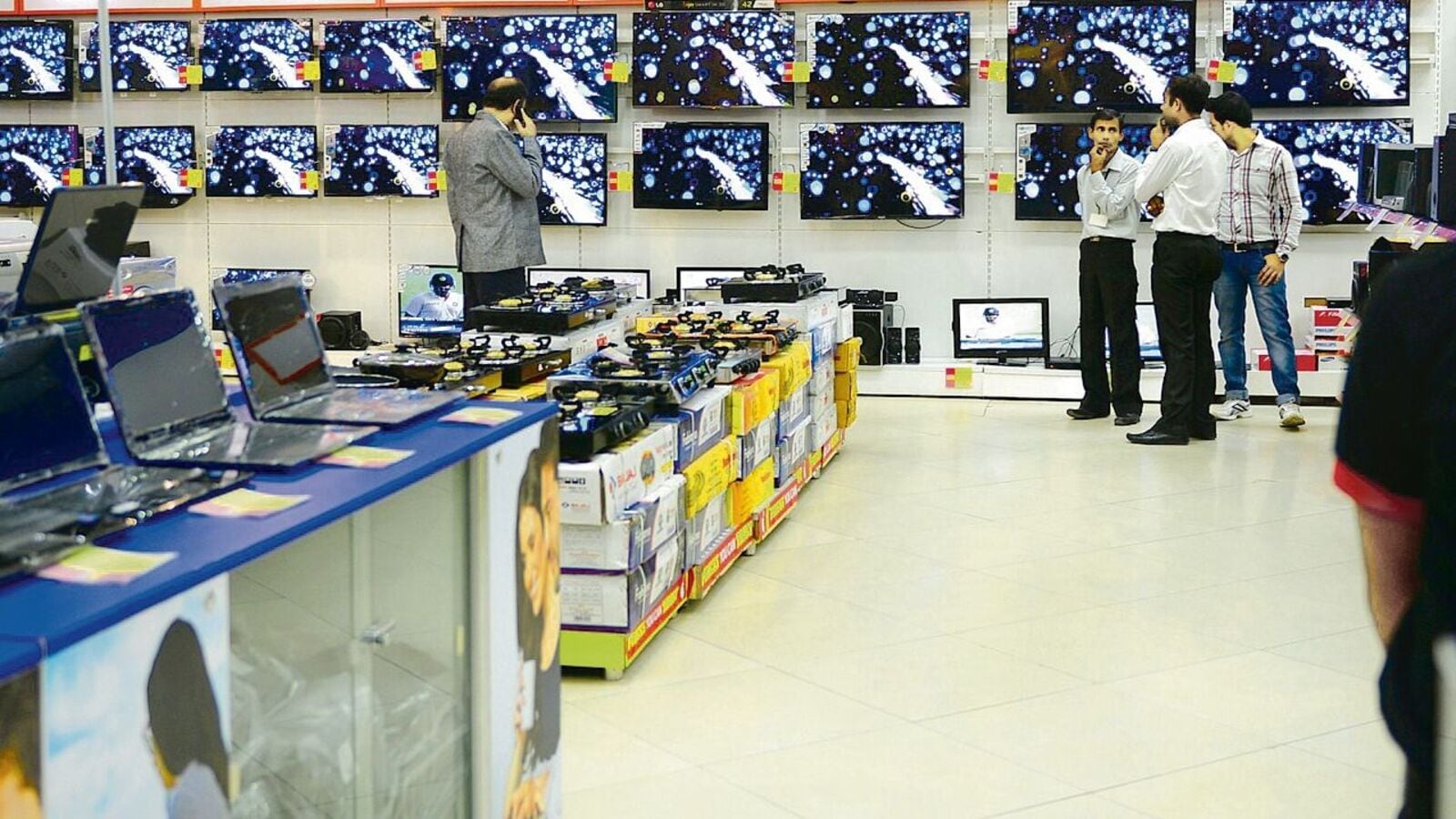
The GST Council on Wednesday, as part of the indirect tax overhaul, cut the levy on televisions of 32 inches and above by 10 percentage points to 18% while leaving smartphones—India’s largest electronics segment—in the same slab, ignoring the industry’s plea for the lowest tax rate of 5%.
Nonetheless, industry stakeholders expect a boost to the entire electronics and appliances market during the country’s eagerly awaited annual sales season.
Manish Sharma, India chairman of Japan-headquartered Panasonic Life Solutions, said the GST reform is good for the brand as “products that were earlier aspirational are now more accessible, allowing a larger section of households to upgrade”.
He added that the GST cut on appliances, coupled with the income tax revision this fiscal, may “significantly boost disposable incomes and consumer sentiment” and “drive higher demand across both urban and emerging markets”.
Big cheer for big screens
“There will definitely be a major fillip to overall TV sales. For TVs and ACs, the GST Council’s approach is on point as it frees up consumption of lifestyle items to boost spending, said Navkendar Singh, associate vice-president, market intelligence data provider International Data Corporation (IDC) India.
The tax cut on TVs and ACs was a “long-standing industry demand”, said Pankaj Mohindroo, the chairperson of industry body India Cellular and Electronics Association (ICEA), adding that the move “will make appliances more affordable, unlock domestic demand, and boost consumption—vital for scaling India’s electronics manufacturing”.
The new tax rate will “expand the market size for domestic producers, create stronger backward linkages in components, expand opportunities for micro, small and medium enterprises, support localization efforts, and reduce import dependency”, added a government official on behalf of the electronics ministry, on the condition of anonymity.
TV and AC makers expect high single-digit growth in sales through 2025.
However, Singh cautioned that much will depend on how brands pass on the benefits to consumers, as the tax relief also gives companies an opportunity to shore up margins in a cut-throat industry.
In 2024, Indians bought 12 million TVs and 14 million ACs, together making up a $13 billion market—$6 billion for TVs and $7 billion for ACs—according to a Mint analysis of data from IDC India and the Consumer Electronics and Appliances Manufacturers Association (CEAMA).
Snub for small screens
The council’s decision to leave tax rate unchanged at 18% for smartphones—which generate nearly $45 billion in annual revenue, according to a Mint analysis of data from three market research firms, including IDC India and Counterpoint—drew mixed reactions from the industry.
To be sure, smartphones alone contributed $7 billion to the Centre’s indirect tax revenue—about 3% of overall GST collections in 2024-25. A cut in the levy to 5% would have reduced this inflow by nearly 70%, to around $2 billion.
Singh said the move may be equated to “a missed opportunity to boost spending and sales of an industry that has been largely stagnant for some time”.
Meanwhile, Mohindroo said the industry body remains hopeful that the government will eventually consider lowering the tax rate on smartphones and laptops, “given their potential to improve affordability and strengthen digital inclusion”.
On the other hand, two senior industry executives said the smartphone segment is not disappointed with the unchanged duty structure.
“While the industry did make representations to the finance ministry, there were no realistic expectations of a tax cut. Given the size of the segment, a sudden reduction to the lowest slab of 5% would have been very surprising,” said one of the two executives, from a top-five smartphone maker, on the condition of anonymity.
The second executive added that a tax cut “would have undoubtedly opened up considerable margin for brands to retailers and even left room for consumer-end price corrections”. “But, this was unlikely to happen, since the segment is profitable, still robust despite slowdowns, and is not under any imminent threat of a consumption decline.”