



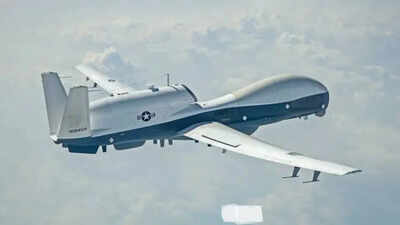
NEW DELHI: A US Navy MQ-4C Triton surveillance drone, estimated to cost over $200 million per aircraft, disappeared from tracking systems after declaring an in-flight emergency over the Strait of Hormuz, raising questions about its fate amid heightened regional tensions.According to data from Flightradar24, the unmanned aircraft had completed nearly three hours of surveillance over the Persian Gulf and was returning towards its base at Naval Air Station Sigonella in Italy when it abruptly changed course.Flight tracking showed the drone turned slightly towards Iran before squawking code 7700 — an international emergency signal — and rapidly descending from its cruising altitude of around 50,000 feet to below 10,000 feet. The aircraft then disappeared from public tracking.
There has been no official confirmation on whether the drone crashed or was shot down.The incident comes just two days after the United States and Iran agreed to a fragile ceasefire linked to the reopening of the strategically crucial Strait of Hormuz, a key global shipping route.
What is MQ-4C Triton
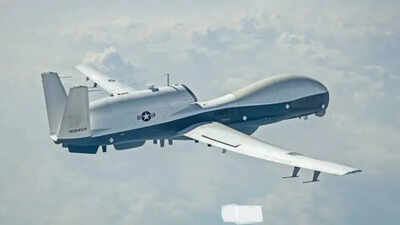
The MQ-4C Triton is one of the most advanced and expensive unmanned surveillance aircraft operated by the US Navy. Developed by Northrop Grumman, the high-altitude, long-endurance drone is designed for persistent maritime intelligence, surveillance and reconnaissance (ISR) missions.Built under the Broad Area Maritime Surveillance programme, the Triton is capable of operating at altitudes above 50,000 feet for more than 24 hours at a stretch, covering vast oceanic and coastal regions. It has a range of around 7,400 nautical miles, making it ideal for monitoring critical chokepoints such as the Strait of Hormuz.The drone works in coordination with aircraft like the Boeing P-8 Poseidon, acting as a high-altitude surveillance platform that provides real-time intelligence over large areas.
Capabilities and operational role
The Triton is equipped with advanced sensors, including an active electronically scanned array radar that can monitor large maritime zones and track vessels by analysing their speed, location and classification.Unlike earlier unmanned systems, it is designed to operate in harsh weather conditions. Reinforced structures, de-icing systems and lightning protection allow it to descend through cloud layers and obtain closer views of targets.It also carries electro-optical and infrared sensors capable of capturing high-resolution imagery and live video feeds, along with electronic intelligence systems that can detect and classify radar signals from ships and other platforms.The aircraft can function semi-autonomously, requiring minimal human intervention once its mission parameters are set. It also acts as a communication relay, linking different assets across the battlefield to provide a comprehensive operational picture.
Induction and deployment
The MQ-4C Triton achieved initial operational capability with the US Navy in 2018 and is deployed across key regions including the Indo-Pacific and the Middle East. The platform is considered central to US maritime surveillance strategy, particularly in sensitive areas such as the Gulf region.With its ability to remain airborne for extended periods and monitor large areas continuously, the Triton plays a crucial role in tracking naval activity, supporting search and rescue missions, and enhancing situational awareness for military operations.