





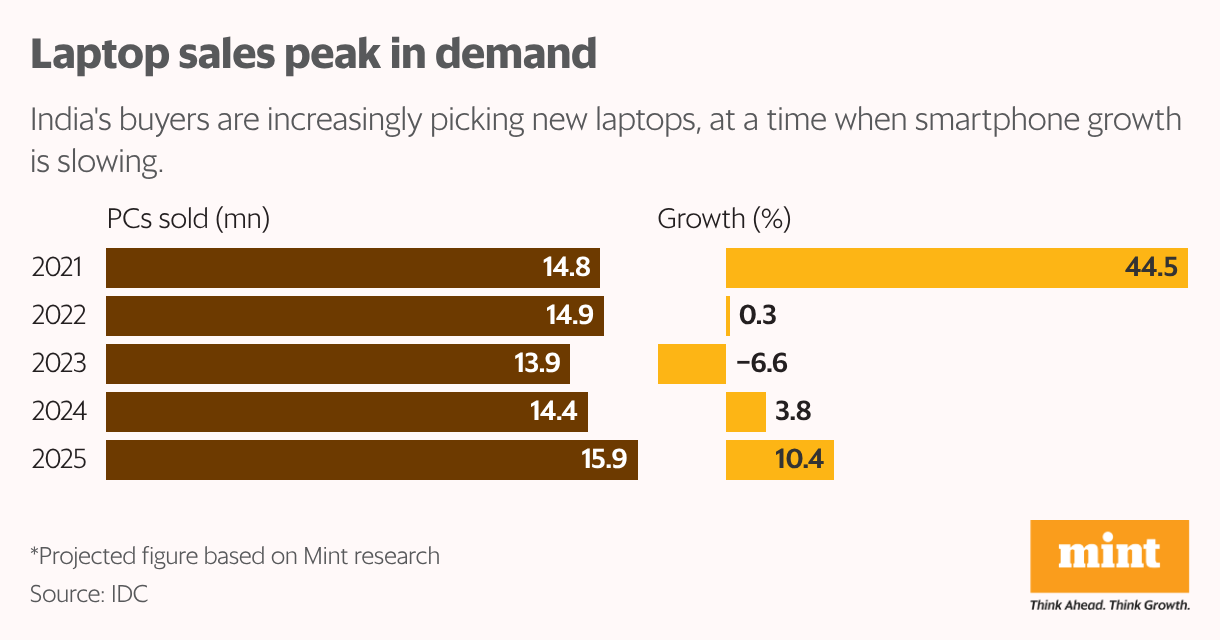
Companies sold a record 15.9 million personal computers, including 11.4 million laptops, in India in 2025, according to data from Counterpoint and two other market research firms. That compares with 14.4 million PCs sold in 2024, of which 10.1 million were laptops.
By comparison, 154 million smartphones were sold in India in 2025, marking yet another flat year, according to data released on 20 January by market researcher Omdia (formerly Canalys).
“If you look at the pandemic buying craze, there were multiple market shortages due to the supply chain being hit, and people bought whatever laptops they could buy within tight budgets. That was a very different economy. Now, almost five years since then, buyers are looking to upgrade to better laptops at higher price points, which is fuelling a strong market for PCs in India,” said Navkendar Singh, associate vice-president at market research and consultancy firm International Data Corporation (IDC).
“There is ample room for laptop sales to grow as it has a net base of about 250 million users in the country,” he said. “With this level of penetration, there is definitely enough room for organic buyers, in addition to those replacing their hastily purchased devices from five years ago.”
Laptops generally account for about 75% of PC sales in India. The average price of a laptop sold in India in 2025 was around ₹43,000, according to Counterpoint. Laptops accounted for about $5-6 billion of the $90 billion in consumer electronics revenue last year.
Enterprise, government demand
IDC data collated by Mint showed that total PC sales in India spiked to 14.8 million devices in 2021 from 10.4 million in 2020 and 11 million in 2019, driven by a rush to comply with at-home work and education mandates amid the pandemic. While PC sales remained largely flat in 2022, volume dipped 7% in 2023 before recovering 4% in 2024.
American firm HP is India’s biggest laptop seller, with a market share of 27-29%. China’s Lenovo is second, with an 18% market share in the September quarter of 2025, followed by US company Dell and Taiwanese firms Acer and Asus. Queries emailed to HP, Lenovo and Dell were yet to elicit responses at the time of publishing.
Fresh demand for laptops “has come from segments like students, gaming users, content creators and small businesses that are becoming more digitally dependent”, according to Anshika Jain, senior research analyst at market research firm Counterpoint. “Enterprise and government digitization initiatives have also played an important role in boosting demand. Overall, the market growth has been healthy and supported by both cyclical replacement and new demand drivers.”
Smartphone sales struggle
The surge in laptop sales contrasts with muted demand for smartphones, India’s largest consumer electronics category, which has remained below its Covid-era peak in 2021. Since hitting a high of more than 160 million units in 2021, smartphone sales have remained below that level.

Industry stakeholders say the lack of new features, longer usage spans, and a saturated market, due to India’s base of over 250 million feature phones not upgrading to smartphones, are the key reasons sales are below the 2021 peak.
The December-quarter earnings of India’s top three listed electronics manufacturers highlighted the diverging trend. Syrma SGS, which assembles laptops for several brands in India, saw revenue grow 10%, while Dixon, which earns nearly 70% of its revenue from mobile phone assembly, reported a 28% decline in its topline.
Words of warning
Experts, however, warn that it may be too early for PC companies to cheer the surge. Rising costs of memory chips have already increased laptop prices by 10-20%, Singh of IDC said, adding that additional hikes could dampen sales in 2026.
Jain of Counterpoint estimates that laptops’ average selling prices in India could increase by 8% this year. “Entry-level buyers may delay purchases or opt for lower-spec models, while premium and professional segments such as gamers, creators and enterprise users are less price-sensitive and will continue to drive demand.”
Singh also cautioned against reading too much into the ‘AI PC boom’, saying while sales numbers are climbing, customers aren’t actually walking into stores specifically asking for AI features. Instead, because AI chips are now the standard hardware in mid-to-high-end laptops, every purchase at that price point is automatically counted as an AI PC sale, whether or not the buyer cares about AI. “It’s a bit like saying 5G smartphone sales are growing in a market where all smartphones have 5G connectivity.”