




Batra didn’t defend the product. He leaned, slightly. “Maaji, you call me your son. Yet wouldn’t a mother want her son to get promoted?”
She hesitated, then told the younger man beside her to pull several cartons from the stack.
Standing a step behind, Vineet Agrawal—only months into his first sales job—watched the exchange. Nothing about it felt like a ‘pitch’. Batra wasn’t selling soap so much as selling trust, and he had turned the conversation with one line.
Later, in Punjab’s turbulent years, when markets were broken by curfews and armed checkpoints, Batra was once on a bus that was hijacked. What saved him was not luck but a connection: an older woman he had befriended on an earlier trip recognized him, spoke to the hijackers, and convinced them to let him go. He was back at work the next day.
For Agrawal, it was a lesson he never forgot: in sales, relationships could mean the difference between walking away with an order—or walking away from it all.
A few weeks later, in another small Punjab town, Agrawal was with Ayaz Hussain, a senior whose name carried weight in Wipro’s sales team. Ayaz was carrying one of the toughest products in the portfolio—787 laundry soap, a byproduct of vanaspati or hydrogenated vegetable fat.
Detergent bars had already entered the market, with far superior cleaning quality. The 787 bar was cheap, low-grade, and if unsold, dried up to become rocky within a month or two. Retailers despised it.
On that day, outside a shop, Ayaz saw several 787 bars scattered on the street, treated like garbage. He stopped. Without a word, he bent down, picked up each piece, brushed the dust off with his handkerchief, and carefully stacked them again. The shopkeeper stared at him, puzzled. Ayaz looked up and said softly but firmly in Hindi: “This soap is my bowl of sustenance. Please respect it.”
Agrawal saw it clearly. In a moment that could have been humiliating, Ayaz’s back stayed straight. Humility and dignity, at the same time. Years later, long after Ayaz had passed away in his early 40s, that moment would remain etched in Agrawal’s mind as the clearest example of what it meant to carry yourself in sales.
It was the late ’80s, and Wipro was still a small, almost invisible player in many distributors’ portfolios. In Delhi, founder Azim Premji and Agrawal visited Hemraj, a chemist and distributor whose shelves were dominated by giants like Nestlé and Britannia. Wipro’s sales barely registered in his books.
The meeting took place over lunch at Gaylord, the white-tablecloth Connaught Place institution where Delhi’s business and political set had been sealing deals since the 1950s. Premji didn’t open with a pitch or a grand plan. He simply leaned forward and asked, ‘Doctor saab, are you making money?’”
That single question cut through everything—no jargon, no defence of the brand, just a direct concern for the man’s profitability. For Hemraj, it was startling; no chairman from the bigger brands he carried had ever asked for it. For Agrawal, it was a masterclass in what really sustained relationships in sales: the other person’s business had to work before yours ever could.
These were his real management lessons—Batra’s wit, Ayaz’s dignity and patience, Premji’s plain-spoken clarity.
The smell of Wipro
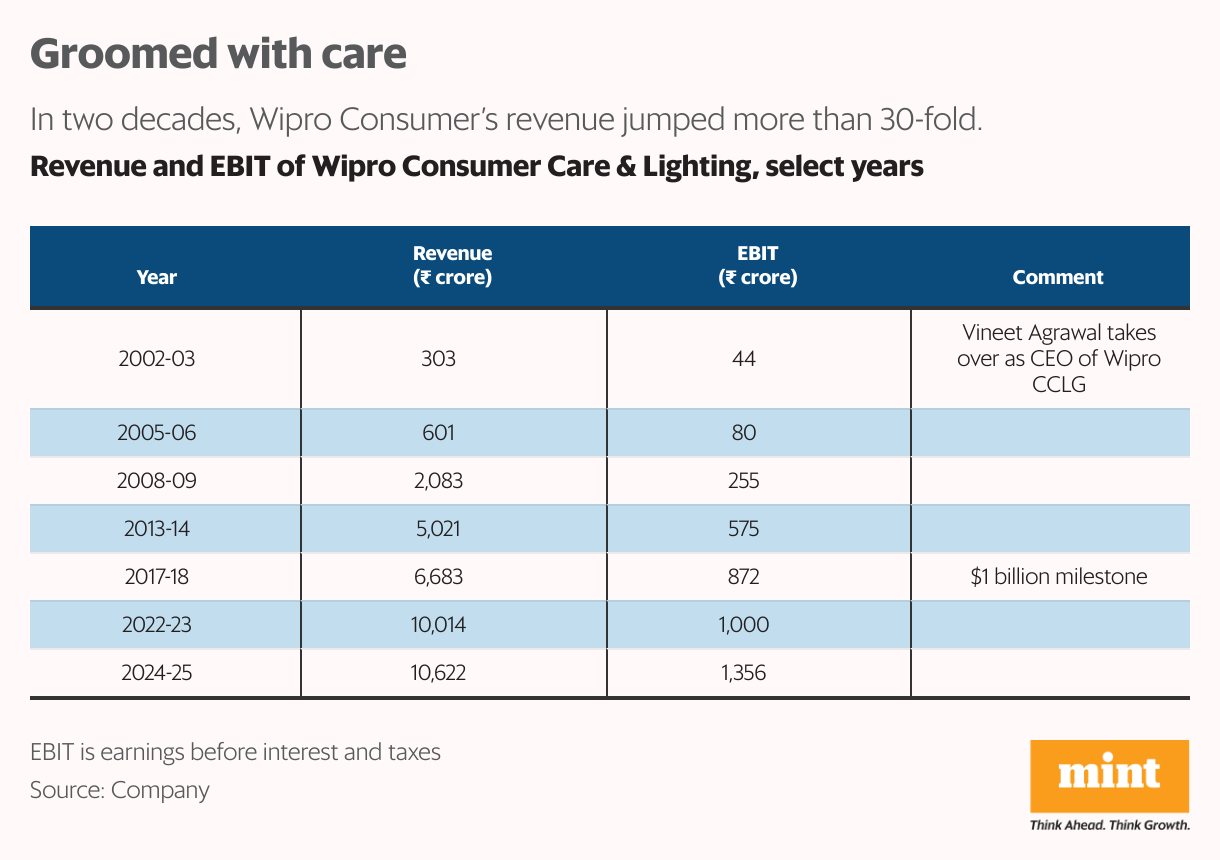
When Vineet Agrawal became the chief executive officer (CEO) of Wipro Consumer Care & Lighting in 2002, the business had annual revenues of ₹300 crore (about $60 million), with operations concentrated in soaps, vanaspati and lighting. By 2025, revenue had grown more than 30-fold to ₹10,600 crore (about $1.2 billion), with a presence in over 60 countries. Over two decades, he led 15 acquisitions worth more than $1 billion, while turning Santoor into one of India’s largest soap brands by value.
It was a transformation built not on a single big-bang move, but on two decades of field-hardened instincts. The habit of reading markets like shop counters, knowing when to walk away, when to press, and when to bet big.
He pulled back from national pushes when the economics didn’t work, poured resources into states where the brand already had life, and entered new categories only when the fit was right. Integration was never just about cost synergies; it was about bringing in new brands without eroding what he and his predecessors called “the smell of Wipro.”
No more a joke
Inside Wipro Enterprises, which houses Wipro Infrastructure under Pratik Kumar and Wipro Consumer Care under Agrawal, executives and long-time Wipro veterans have started to say aloud what used to be passed off as a joke: that the non-IT businesses could one day outgrow the more famous listed IT arm.
The shift began after the 2013 demerger, which separated Wipro’s IT services into Wipro Limited and left its consumer, lighting, and infrastructure businesses under the unlisted Wipro Enterprises.
What was once mentioned with a smile has since become a serious possibility, powered by acquisitions on both sides of the house. As Pratik Kumar put it: “It (the demerger) set us on a path to dream big and realize the untapped potential. We believe we are well on our way.”
He added: “Vineet and I have been colleagues for my entire Wipro journey, and more closely over the last 12 years…since the time we were entrusted with the joint responsibility of Wipro Enterprises. He’s a remarkable person; absolutely thorough, detailed. He has a strong point of view, but is always objective.”

View Full Image
In two decades of crossing paths, CavinKare founder C.K. Ranganathan saw the same traits again and again. An extraordinary commitment to the company, very commonsensical marketing approach. “Great ideas rooted in common sense are finally going to win. And he’s an excellent executor. He did a fabulous job on that,” he said.
The dream company
When Wipro’s recruitment team arrived at Jamnalal Bajaj Institute of Management Studies, in Mumbai, in 1985, Vineet Agrawal’s attention was elsewhere. His ambition was the Tata Administrative Service (TAS), the elite internal cadre of the Tata group. He had already been shortlisted, the only one from his group to make it that far, and the final interview was still to come. Most of his batch mates had jobs in hand.
The visit came at a time when Wipro Consumer Products—until recently a vanaspati maker with its main factory at Amalner in Maharashtra—was trying to reinvent itself. In the first half of the 1980s, the company had launched a hydraulic cylinder business, a fledgling Infotech arm, and was pushing into consumer goods like toilet soaps. Between 1982 and 1992, it began aggressively recruiting bright young people from India’s top B-schools to build a national sales arm.
On campus that day were three from the company: Dileep Ranjekar, then heading operational human resources for Wipro Consumer Products; Shobhana Khandwala, corporate training manager; and another woman whose name Agrawal no longer remembers.
Ranjekar still recalls the first impression. Agrawal walked in wearing a full suit, a formality rare for the occasion. “We were wondering, why has this person come in a full suit? He looked too sophisticated for our kind of business—pounding the streets of various cities and selling consumer products.”
He and Khandwala exchanged a quick aside: Would he fit Wipro’s hard-edged sales culture?
The interview was designed to find out. Wipro recruiters often “de-marketed” the role, laying out the most unglamorous parts in unvarnished detail—the remote postings, the long days on the road, the small-town shops, the work with distributor salesmen.
One question, in particular, stayed with Agrawal: “What is de-marketing?” he was asked. He replied with an example from the LPG shortage of the 1980s, when advertisements had warned that cooking with gas could cause health problems—a way to dampen demand when supply was tight.
Wipro recruiters often “de-marketed” the role, laying out the most unglamorous parts in unvarnished detail—the remote postings, the long days on the road, the small-town shops, the work with distributor salesmen.
In the final round, someone asked about his dream company. Agrawal didn’t hedge: “TAS.”
The panel noted that D.A. Prasanna, a senior Wipro leader, had been in TAS himself. Agrawal replied that if Wipro valued TAS people, hiring him would be consistent with that logic.
Ranjekar offered him the job.
Culture keeper
As early as 1995–96, senior leadership at Wipro Consumer had identified Agrawal as a potential successor to P.S. Pai, who headed the company back then.
Pai felt Agrawal needed structured exposure beyond consumer marketing and sales. The company began grooming him, but he didn’t realize it.
Agrawal was moved to Wipro Peripherals, a hardware business, for a while. Later came stints in quality, corporate communications, and the repositioning of Wipro’s brand identity, assignments he initially questioned. But he took them on and, by Ranjekar’s account, “thrived in those functions.”
Even in those years, outside the consumer business, Ranjekar noticed habits that would stay with him as a leader. Agrawal made elaborate, meticulous notes in meetings—not just bullet points, but full summaries capturing who had said what, and what needed to happen next. He circulated them within hours, and then followed up relentlessly if agreed actions stalled.

View Full Image
By the time Pai retired, Agrawal’s appointment was a natural choice. Ranjekar points out that this wasn’t just about numbers or deals—it was about carrying forward the responsiveness, customer orientation, and refusal to take anything lightly that had defined Wipro Consumer from the start.
“Even today, when you step inside Wipro Consumer Care and Lighting, you can smell that culture,” he said. That was no small feat in a business that had expanded across categories, continents, and 15 acquisitions.
The wait in Mysuru
In 2013, Wipro Consumer was ready to start production on a new spiral compact fluorescent lamp (CFL) line at its Mysuru plant. The machines were installed, the staff hired, distributors primed. All that remained was an environmental clearance from the local pollution control office.
In most companies, Agrawal knew, this final step was a formality—handled with an envelope, a “facilitation” payment, or the arrangement of travel and accommodation for the official.
Industry friends told him exactly how to get it done. “Just fly the inspector in, put him up somewhere nice, and have the papers signed,” one advised, as if explaining common sense. Agrawal refused. He told the inspector they were welcome to walk up the hill and inspect the plant themselves, but Wipro would not pay for the privilege. The inspector didn’t come. The plant stayed idle for weeks, costs mounted.
In the end, the clearance never came. After a few months, Wipro sold the spiral CFL line to one of its vendors and carried on sourcing the product from them. It wasn’t a major commercial loss, but it was a costly reminder that the company’s refusal to bend carried consequences. As Agrawal put it: “We stood by our principles.”
The stance echoed a much older story. In 1984, Wipro had run its Tumkur plant for almost a year on gensets after being denied an electricity clearance. Integrity, in practice, was rarely efficient. But it endured.
Santoor: Losing to win
When Agrawal first stepped into the soap business, Santoor was not a brand anyone expected to win. Launched in 1984 with sandalwood-and-turmeric credentials, it had crawled to ₹60 crore in revenue in over a decade. A relaunch in the mid-1990s was meant to change that—updated packaging, a tweaked shape, a marketing push across the country. “Nothing happened,” Agrawal recalled. “Numbers didn’t move.”
The ambition then was to be everywhere, to match Hindustan Unilever (HUL)’s portfolio state for state. But the reality was thin budgets and scattered impact. HUL brands Rexona and Hamam dominated Andhra Pradesh and Tamil Nadu; Lux ruled the North. Santoor was a distant fourth, sometimes worse. “You cannot under-invest and win,” Agrawal said. “We were trying to fight a war on too many fronts with too few soldiers.”
The numbers forced a reckoning. By the late ’90s, Wipro abandoned the goal of a national push and focused on the markets where Santoor already had some life: Andhra Pradesh (later split with Telangana), Karnataka, Maharashtra and Gujarat. Kerala and Odisha, once on the high-spend list, were dropped.
 ₹2,700 crore, Wipro says. ” title=”Santoor has annual revenue of about ₹2,700 crore, Wipro says. “>
View Full Image
It was a deliberate retreat, but also a shift in thinking. Long before rivals began speaking of “winning in many Indias,” Wipro Consumer was treating each state as a separate market. Agrawal had already seen, selling vanaspati in the ’80s, how pack-size preferences could flip within a single state. North Kerala bought one-kg packs; the south preferred 200- and 500-gram bars. Coastal Andhra bought bigger sizes; Telangana stayed with small bars. The industry’s assumption that customers “graduated” to bigger packs didn’t match the data.
The same ‘go deep’ discipline that lifted Santoor in Andhra and Telangana—where it grew to nearly four times the next brand—became the operating rhythm for everything else.
The new plan was as granular as it was aggressive. In the focus states, the goal was saturation: making Santoor so visible that,“even a blind man should be able to see something has happened to the brand.”
For two months a year, towns turned orange: shopfronts painted the colour of the soap, hoardings and banners in the same shade, product everywhere. The blitz skipped big cities like Hyderabad and Visakhapatnam in favour of Warangal, Vijayawada, Nellore and Guntur, markets big enough to matter but small enough to avoid immediate attention from competitors. “The competition didn’t notice us,” Agrawal said, “and that was the point.”
The competitive target was chosen carefully. Santoor’s “younger skin” promise put it closest to Rexona, not Lux. Rexona was strong in some southern markets but was a weaker priority in HUL’s portfolio. The moment came when HUL rebranded it as “Lux Rexona,” blurring its skin-care positioning with Lux’s glamour narrative. Agrawal called it “a golden opportunity” and sharpened Santoor’s attack, holding its line: a married woman, a mother, mistaken for someone younger.
“We didn’t talk about glamour, fairness, or turning into a film star overnight,” he said. “It was about timelessness for the everyday woman, the idea that you could be yourself and still surprise people.”
We didn’t talk about glamour, fairness, or turning into a film star overnight.
—Vineet Agrawal
Years before the brand actually closed in on Lux, the ambition was quietly written down. At a 2007 strategy offsite, one breakout group scribbled a headline across their flip chart: “Santoor will overtake Lux.” Agrawal kept the sheet and slid it into his desk drawer.
The years that followed were long and bruising. Retailers said Santoor would never beat Lux. Competitors dismissed it for lacking a celebrity face. Growth slowed in core states at times, and younger consumers—college students, young professionals with little brand loyalty—were a harder sell.
When the turn finally came, it came quietly. By 2018-19, Santoor’s revenue had reached ₹2,065 crore, making it India’s second-largest soap brand by value, behind only Lifebuoy, according to Forbes.
Today, by company estimates, Santoor has annual revenue of about ₹2,700 crore.
Nielsen’s retail audit still lists Lifebuoy and Lux as the top two, but Wipro says those samples undercount its sales; it has long benchmarked progress against HUL’s own brand disclosures.
For Agrawal, the victory wasn’t just about market share. It was proof that the instinct to pull back—something he’d learnt on the shop floor, choosing which counters were worth fighting for—could be the smartest way to win. That going deep in a few places could matter more than going wide. And that the same patience you needed with a single reluctant shopkeeper could be applied to building a ₹2,000-crore brand.
Premji’s lunch
A year before Wipro’s biggest deal, there was one that got away. In 2006, Agrawal believed Wipro Consumer had a shot at entering the growing packaged foods business by acquiring MTR Foods, a brand with a portfolio of ready-to-eat meals, instant mixes and spices.
At a review meeting with Azim Premji, Agrawal decided to let the products speak for themselves. Lunch that day was entirely MTR—dal, rice, gulab jamun—served without comment. Only after the plates were cleared did he tell Premji where the food had come from.
Premji smiled. “I liked the dal. Can you give me some packs? I’ll ask my cook to make it,” he said.
The compliment didn’t change his mind. He wasn’t convinced about a food business fitting Wipro’s core, and the bid was dropped.
“If we had done MTR,” Agrawal would say later, “maybe we’d never have done Unza.”
The lesson stayed with him. Pass on good deals if they don’t fit, so you can go all in, on the right one.

View Full Image
The big bucket
In July 2007, Wipro Consumer closed what was then the largest deal in its history—$296 million for Singapore-based Unza, a personal care company with brands across Southeast Asia, the Middle East, and Africa. On paper, it was a ₹600-crore company buying another ₹600-crore company. Inside and outside the industry, the move prompted doubt. “People thought we’d choke on it,” Agrawal said.
The bidding was competitive and tense. Dabur and Godrej were also in the race, both with more established overseas FMCG track records. The process was compressed into weeks, with repeated management presentations to Unza’s board and owners. Agrawal recalls late nights with bankers, the weight of questions about whether Wipro could match the financial terms of its rivals, and the awareness that one misstep could swing the deal in the competition’s favour. “There was a moment when we thought they’d pick one of the others,” he said. “We were the underdogs. But that made us hungry, nimble, and very clear on how we’d integrate without losing culture.”
When the deal was signed, the real work began. Unza had a strong leadership team and entrenched ways of working across markets from Vietnam to the UAE. Early on, there was uncertainty on both sides: whether a company headquartered in Bengaluru could read the nuances of Southeast Asian markets, and whether Unza’s managers would adapt to Wipro’s systems without losing their local speed of decision-making. Agrawal pushed for a middle path—putting Wipro’s governance and integrity policies in place, but leaving day-to-day market calls to Unza’s teams.
The first year was not without friction. Debates over pricing discipline, promotional spends, and reporting cadence tested both sides. Integration also changed the organization’s own sense of scale. Senior leaders took on international roles for the first time. It opened space for mid-level managers to step up in India.
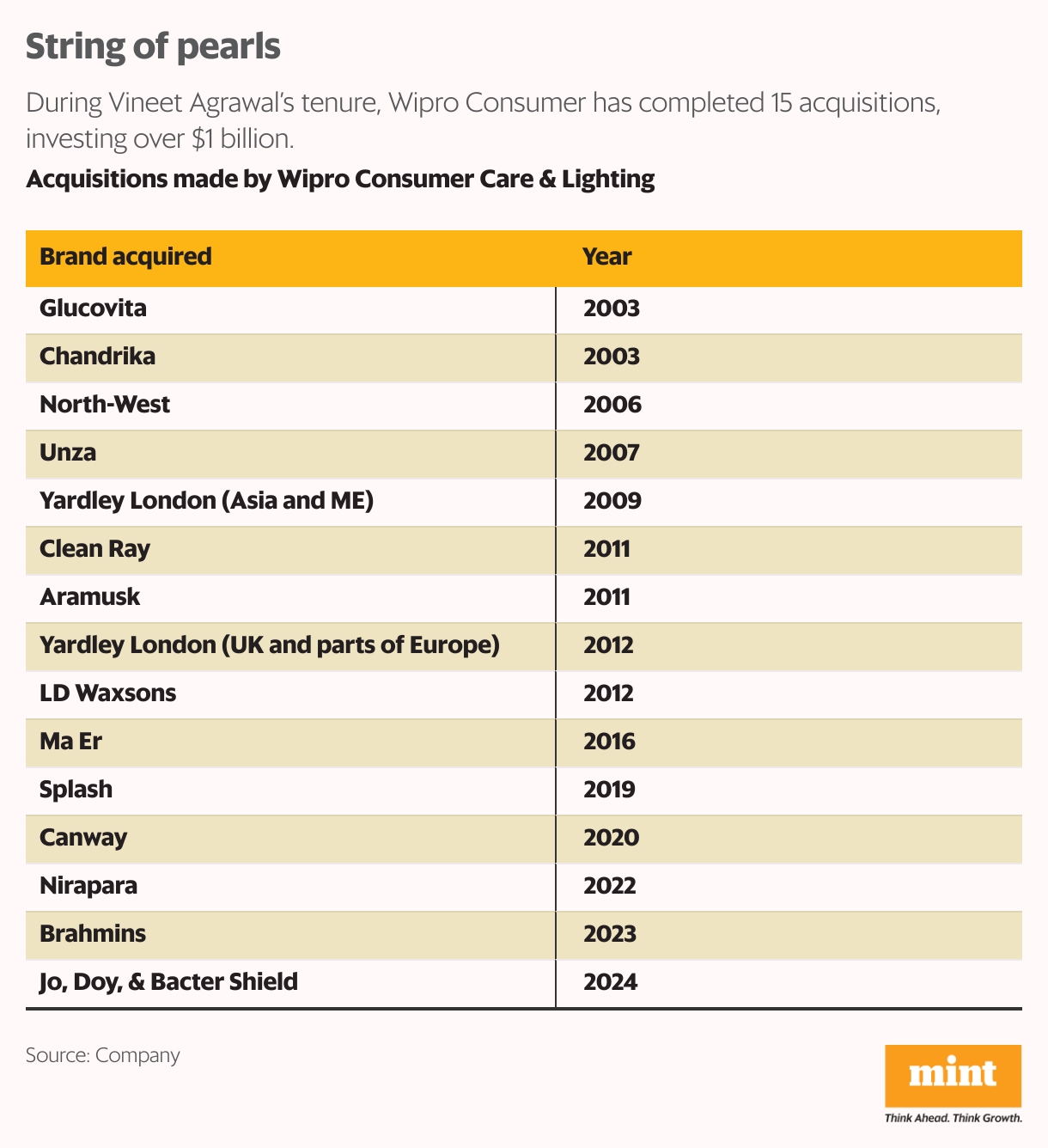
The approach had precedent. In 2003, Wipro had acquired Chandrika, a 60-year-old Ayurvedic soap brand with a loyal base in Kerala and among Malayali consumers overseas. It was a single-product business with limited reach, and the family owners were wary of losing its identity. Agrawal’s proposal was that Wipro would leave the formulation and packaging untouched but expand its distribution to every market with a Malayali presence. Negotiations were slow and personal, with repeated assurances that Chandrika’s “soul” would remain intact. That promise was kept—the bar looked, smelt, and felt the same, but its reach grew dramatically.
From there, acquisitions came steadily, each chosen for strategic fit and market potential. In 2009, Wipro bought Yardley’s Asia and Middle East operations for $45.5 million, adding the UK and parts of Europe in 2012. That same year, LD Waxson, a Singapore skincare company, was acquired for $123.5 million, giving Wipro a stronger position in markets Unza had opened.
Later deals included Ma Er in 2016, Splash in 2019, and two Kerala food companies—Nirapara (2022) and Brahmins (2023)—which marked Wipro’s entry into packaged foods in the south. In 2024, it added Jo, Doy, and Bacter Shield to its personal care portfolio.
For each acquisition, Agrawal said, the same question applied: could the business grow without eroding what Dileep Ranjekar called “the smell of Wipro”—responsiveness, seriousness about customer feedback, and speed of decision-making.
By 2022-23, revenue crossed ₹10,000 crore. Inside the company, banners simply read ‘ ₹10,000 crore,’ and everyone received a tenure‑linked cash award, a signal that the result belonged to the whole organization.
By 2025, the company had completed 15 acquisitions worth more than $1 billion. It operates in over 60 countries with revenue of ₹10,600 crore—a scale that, when Agrawal became CEO, had seemed distant.
By 2022-23, revenue crossed ₹10,000 crore. Inside the company, banners simply read ‘ ₹10,000 crore,’ and everyone received a tenure‑linked cash award.
From the outside, those deals looked straightforward. From the inside, says Ranganathan, they were the mark of a CEO who understood that buying is easy; making it work is rare.
“I’m amazed at the way he went about acquiring various brands and making them work, including overseas. Very few make acquisitions work. That speaks loudly about his leadership style,” the CavinKare founder said.
The shoes to fill
Now, as Agrawal steps down—he is retiring in January 2026—Wipro Consumer has chosen another insider: Kumar Chander. He once took a regional role in Southeast Asia after the Unza deal. Later, he ran India and international businesses, and has spent years inside the company’s sales-and-brand operating rhythm.
For Agrawal, it’s continuity of culture over theatrics.
That continuity, Ranganathan points out, didn’t just happen. It was the product of a promoter who knew when to step back, and a leader who knew how to use that space.
“Able teams aren’t accidental. You create them. And an excellent board and encouraging promoters matter too,” he said. “Not to undermine Premji’s contribution—working with a promoter who is encouraging, not breathing down the neck every time, allowing you to make mistakes and still grow—that’s very important. The company gained a lot, Vineet has gained, we have gained.”
Able teams aren’t accidental. You create them. And an excellent board matters too.
—C.K. Ranganathan
For Ranganathan, the measure of Agrawal’s legacy will be in how his successor handles the disruptions already reshaping the consumer business. “Vineet was leading from the front on artificial intelligence (AI). He told me that all the company’s social media ads are AI-created now. That’s a very bold move,” he said.
Handling AI disruption end-to-end is going to be one big challenge for his successor, along with quick commerce, personalization, and continuing the legacy of good acquisitions, he added.
The next chapter
Agrawal talks about wanting to spend part of his next chapter teaching physics. On paper, it sounds like a leap—from selling soap and skincare to working through equations on a blackboard. He doesn’t see it that way.
“It’s still about making something clear to someone else,” he said. “Meeting them where they are. Getting them to see it.” In his mind, it’s the same work, the same patience, the same reading of pauses. Only with a different subject across the table.
“No matter who you are or what you’ve done before,” Agrawal said, “in the end, it has to translate into real sales. Rest is all immaterial.”