





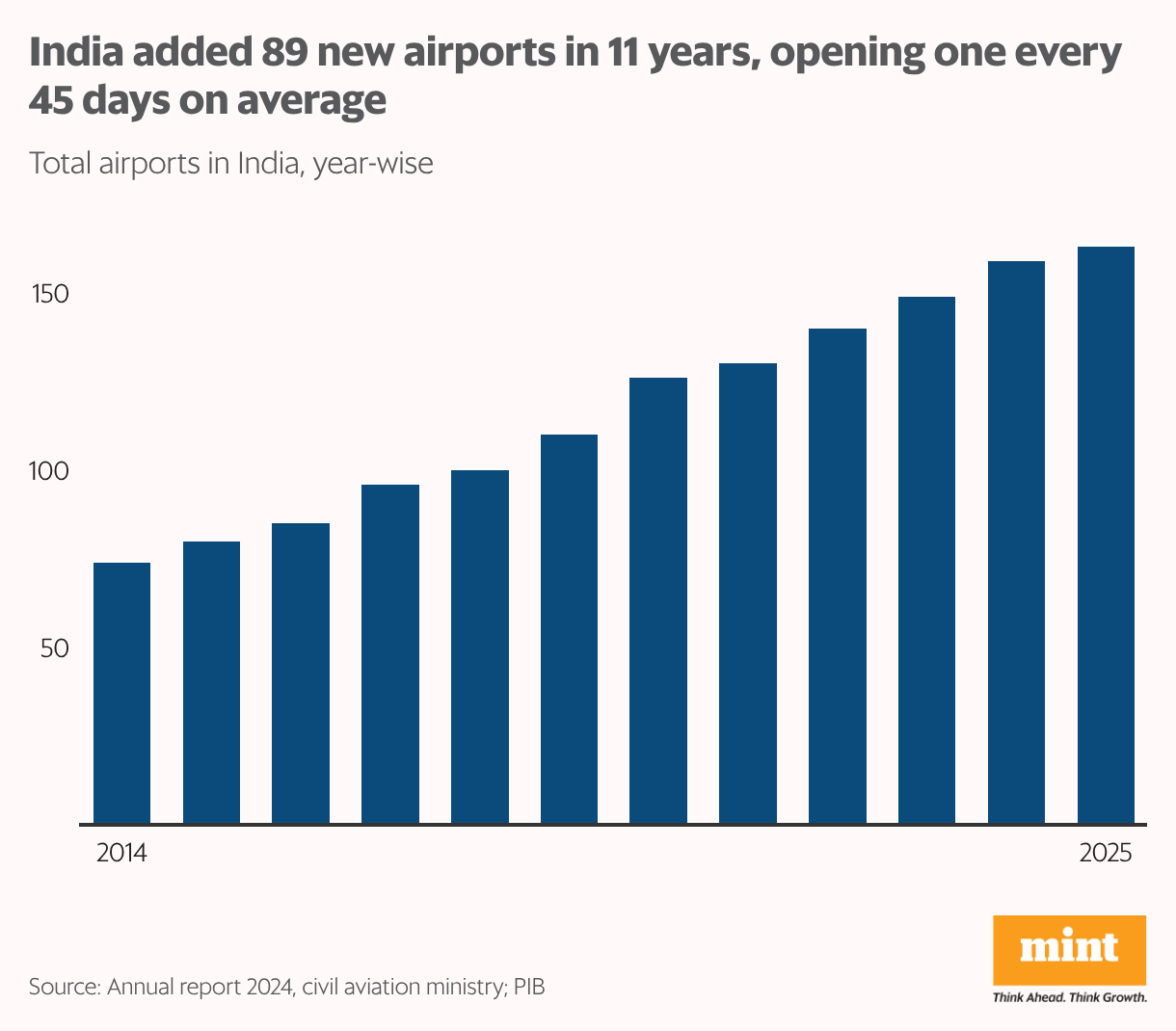
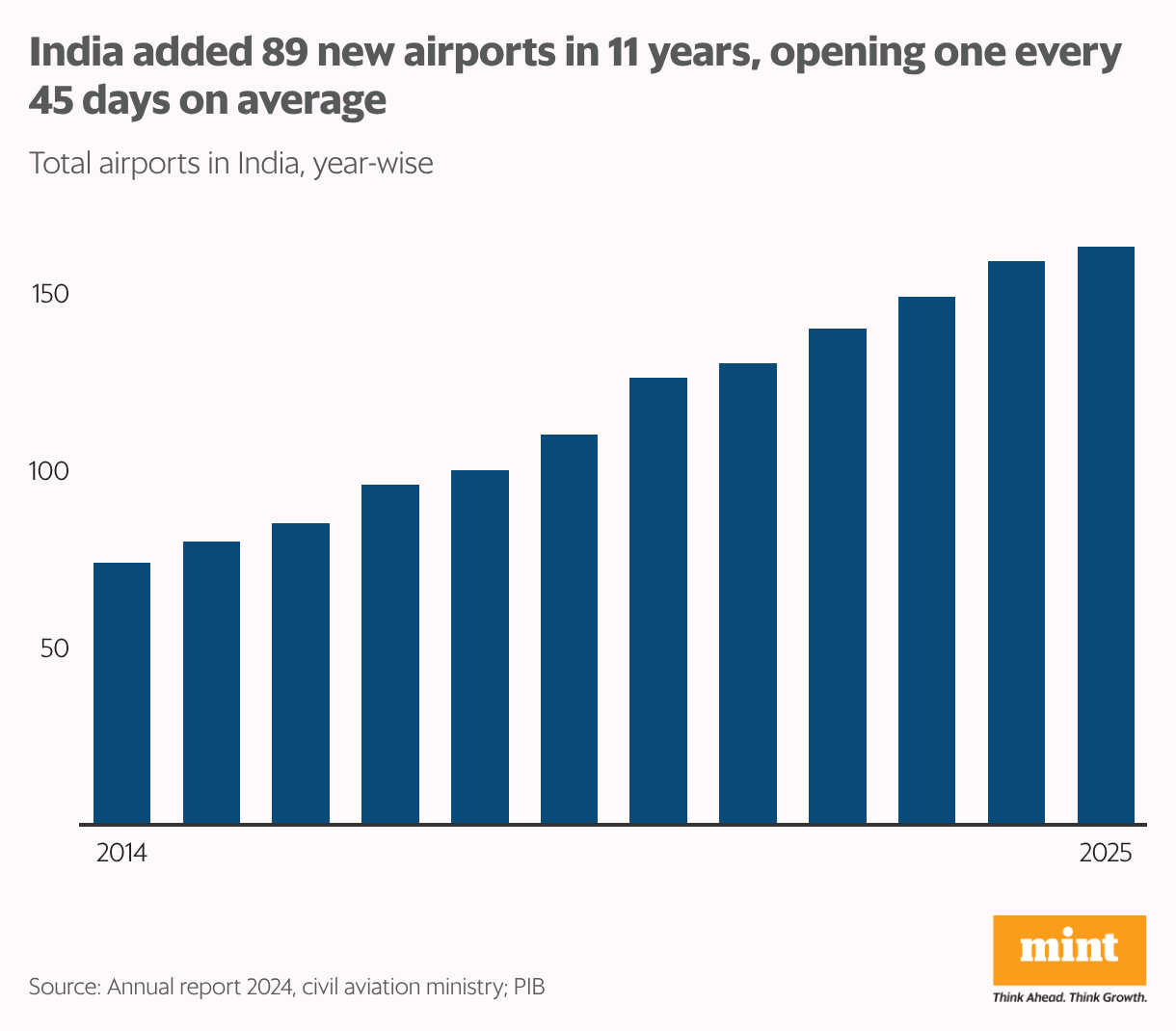
The bigger question, however, is whether this expansion is sustainable.
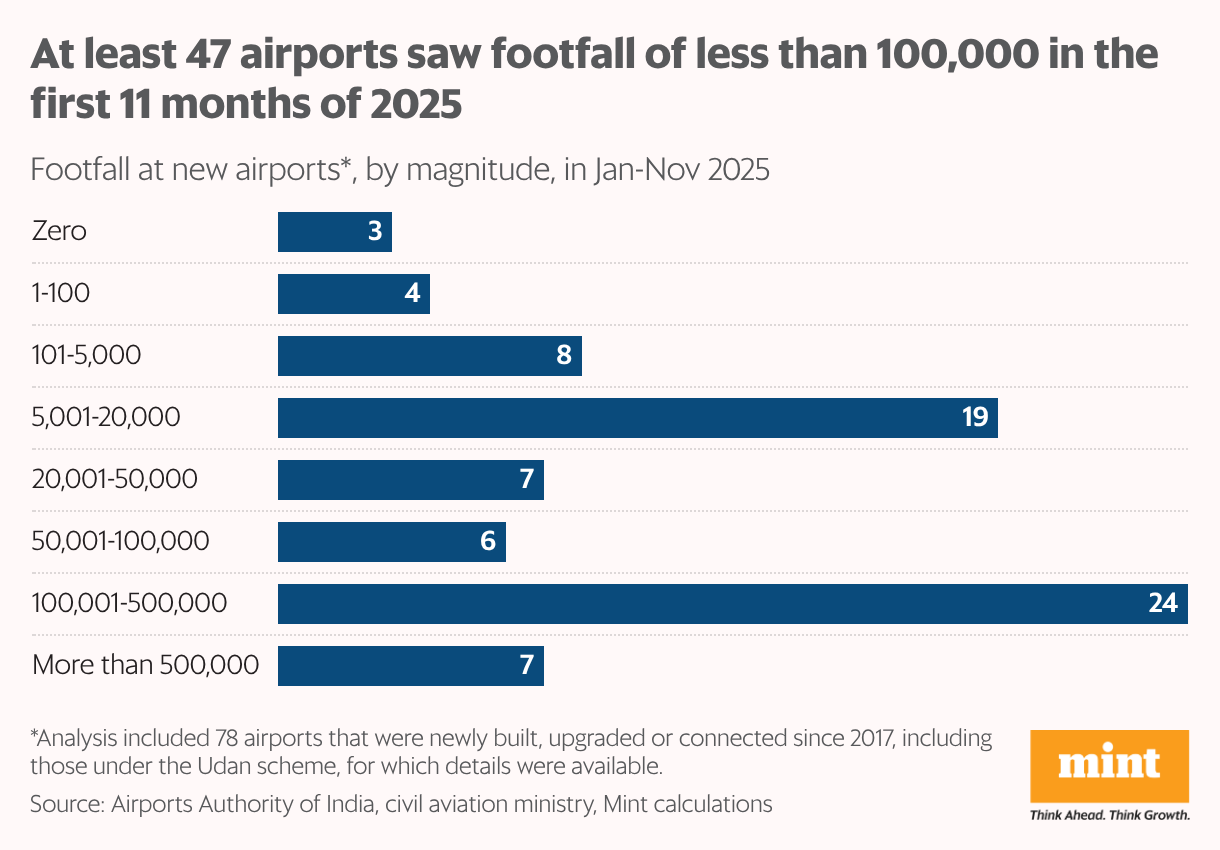
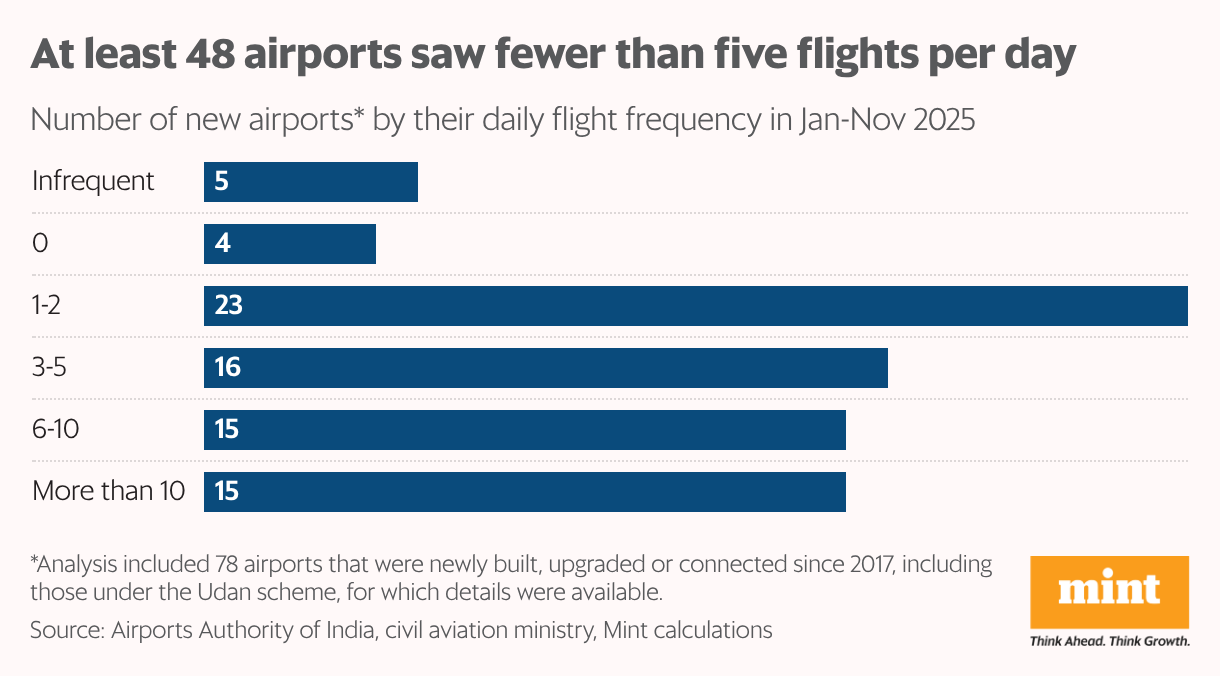
A Mint analysis of 78 airports built, upgraded or connected since 2017 shows that nearly 60% recorded fewer than 10,000 domestic passenger footfalls a month on average in 2025. Aircraft movement was also thin, with close to the same proportion seeing fewer than five domestic flights a day. By comparison, the median Indian airport handles about 24,000 passengers a month and around seven aircraft movements daily.
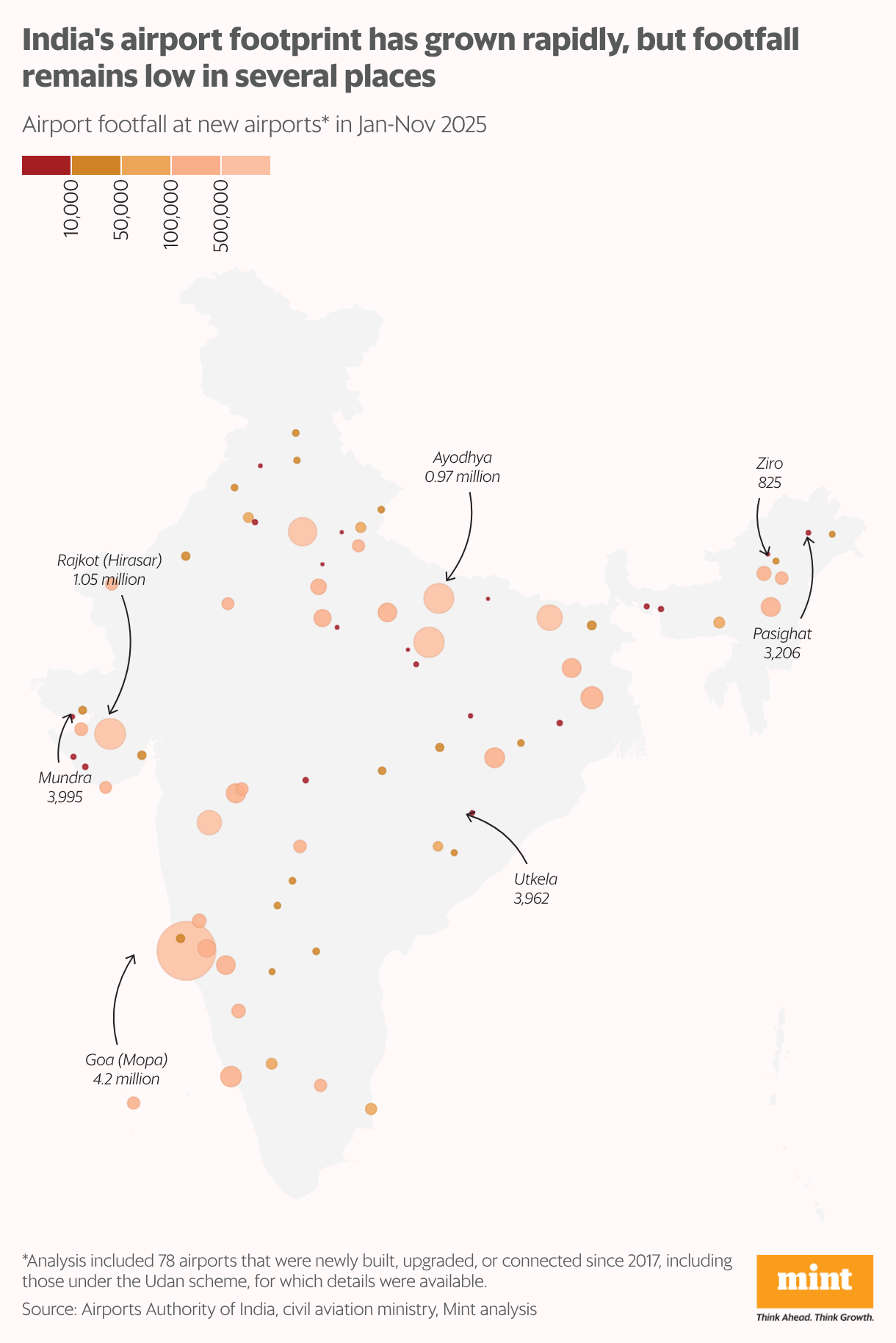
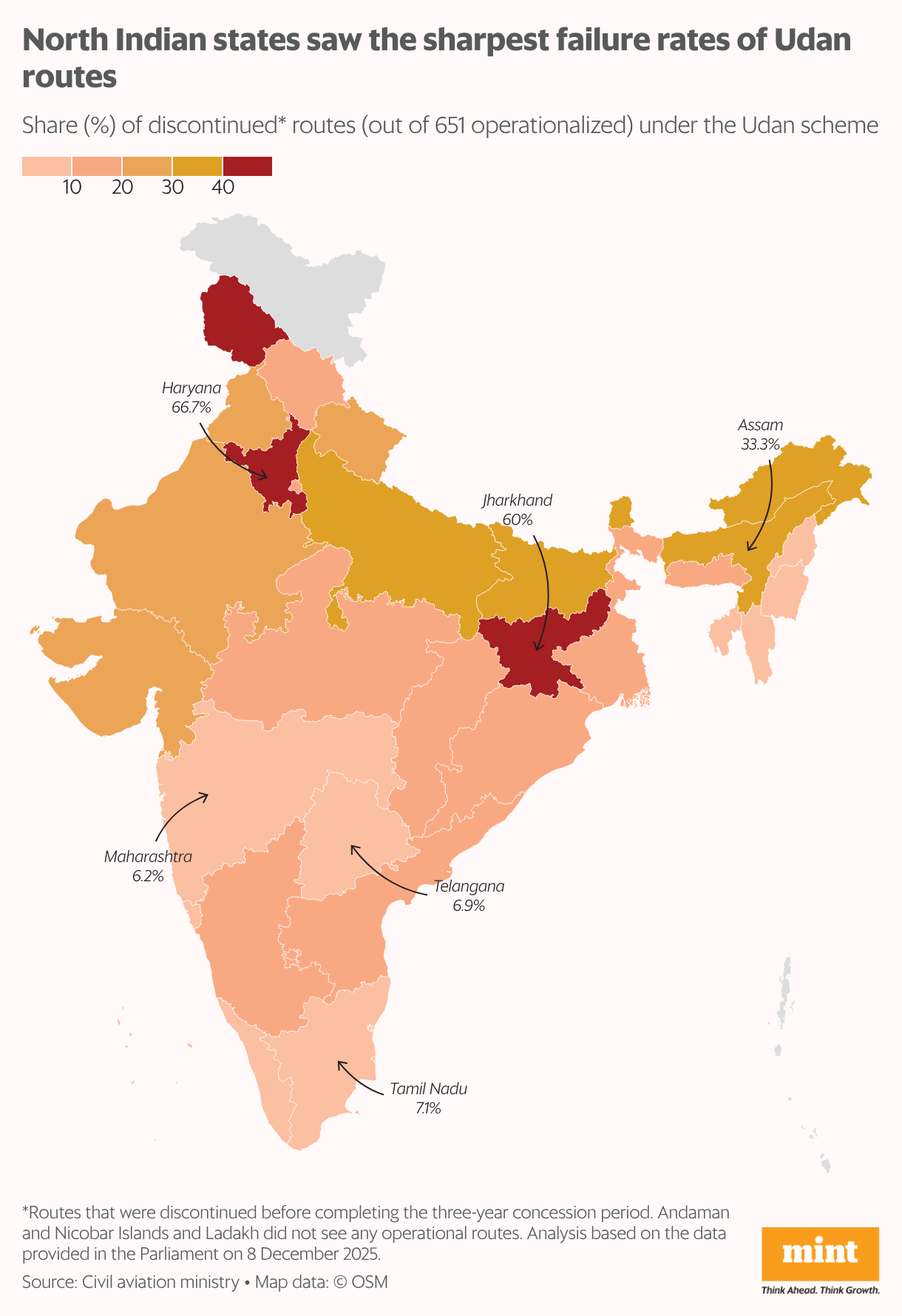
This is not to say that all expansions have been underwhelming: Rajkot (Hirasar), Prayagraj and Ayodhya clocked in nearly a million passenger footfalls until November in 2025, signalling the immense potential many of these hubs may hold. However, there were also at least 15 airports and 123 routes that have been discontinued under the government’s Udan (Ude Desh ka Aam Nagrik) scheme—roughly accounting for a fifth of the total.
The reasons for the failure of many airports and routes are several, including a lack of demand in many Tier-2 and Tier-3 cities and a shortage of airline resources to complement the airport infrastructure. The recent failure of IndiGo, a dominant player in the aviation market, to comply with new Flight Duty Time Limitations (FDTL) paralysed the entire aviation system last month and exposed the need for a holistic development of the aviation sector, beyond airports.
“A lot of regional airports have come up even before there was sustained airline interest or where there was actual local demand in place,” said Ankita Shah, vice president at Elara Capital.
The progress and the pangs
The progress in airport infrastructure all over the country picked up pace after the government launched Udan in 2016—a move to democratize aviation by making air travel affordable and accessible to common people in Tier-2 and Tier-3 cities.
The first Udan flight took off from Shimla’s Jubbarhatti airport in April 2017. Eight years later, that same airport operated just two flights per day on average in 2025. By December, it was included in the list of airports that were temporarily suspended.
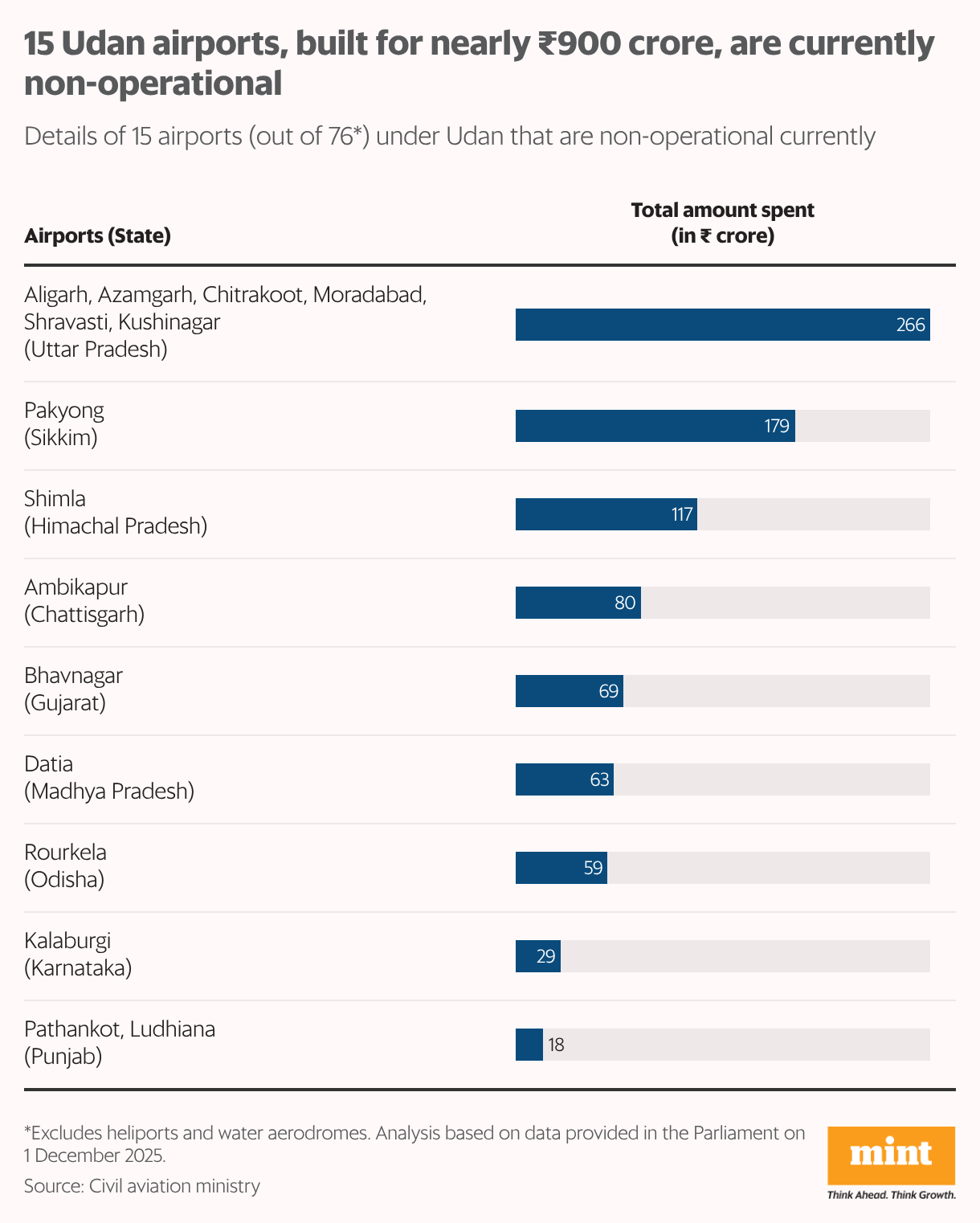
Along with Shimla, airports in Ludhiana, Pathankot, Aligarh, and Pakyong, are among the 15 airports, built with an investment of nearly ₹900 crore, that are currently non-operational.
The government informed the Parliament that these were “temporarily non-operational” due to various reasons, including completion of the three-year Viability Gap Funding (VGF) tenure (that is the end of financial support from the government), shortage of aircraft, and leasing issues, among others. Out of the 15, the maximum non-operational status was in Uttar Pradesh at six.
There were several other airports that performed poorly in 2025. Airports like Mundra in Gujarat, Utkela in Odisha, and Pasighat in Arunachal Pradesh witnessed only 3,000-4,000 passenger footfall in the first 11 months of 2025. As many as 19 airports witnessed less than 20,000 passenger footfall.
The heartening news is that there were 31 airports that saw over 100,000 passenger traffic, including seven that had over 500,000 passenger traffic. These seven airports—Goa (Mopa), Rajkot (Hirasar), Prayagraj, Ayodhya, Hindon, Darbhanga, and Shirdi—however, suggest that an airport’s success can hinge on a destination’s popularity, cultural and tourism values, and proximity to major metro hubs.
Flying high
Even as the track record of new or revived airports signals the need to slow down on creating more airports, the government is aiming for at least 50 more airports over the next five years (continuing the current strike rate).
For 2047, the 100th year of India’s independence, the government has set a target of taking the number of airports higher to 350-400 from 163 currently and passengers to 1.1 billion from 350 million currently.
Even going by the government’s ambitious aim, airlines will be ready to serve, in over two decades, only 14% of over 7 billion passengers that Indian Railways is already serving currently. The success of India’s regional airports will depend on a broad-based economic growth.
“The amount of traffic at any airport is a function of the traffic in the surrounding area, which in turn depends upon the economic activity, international trade and investment, and global connectivity of the city,” said Suprio Banerjee, vice president at Icra Ltd. Banerjee, however, bets on the future.
“Although the percentage contribution of traffic from Udan airports to total traffic remains marginal, it has healthy long-term potential, given the significant under-penetration of air travel in India currently,” he added.
At the same time, experts also believe that the rapid expansion in airports that took place since 2017 played an important role in providing connectivity to many regional areas. However, it has been a supply-side measure, and demand has yet to catch up. The next phase of expansion should wait for a sustained trend of increase in demand in Tier-1 and Tier-2 cities.
“The key performance indicator should change from the number of airports to how the traffic intensity is moving and how the average spend on the airport per person is improving,” Shah said.