




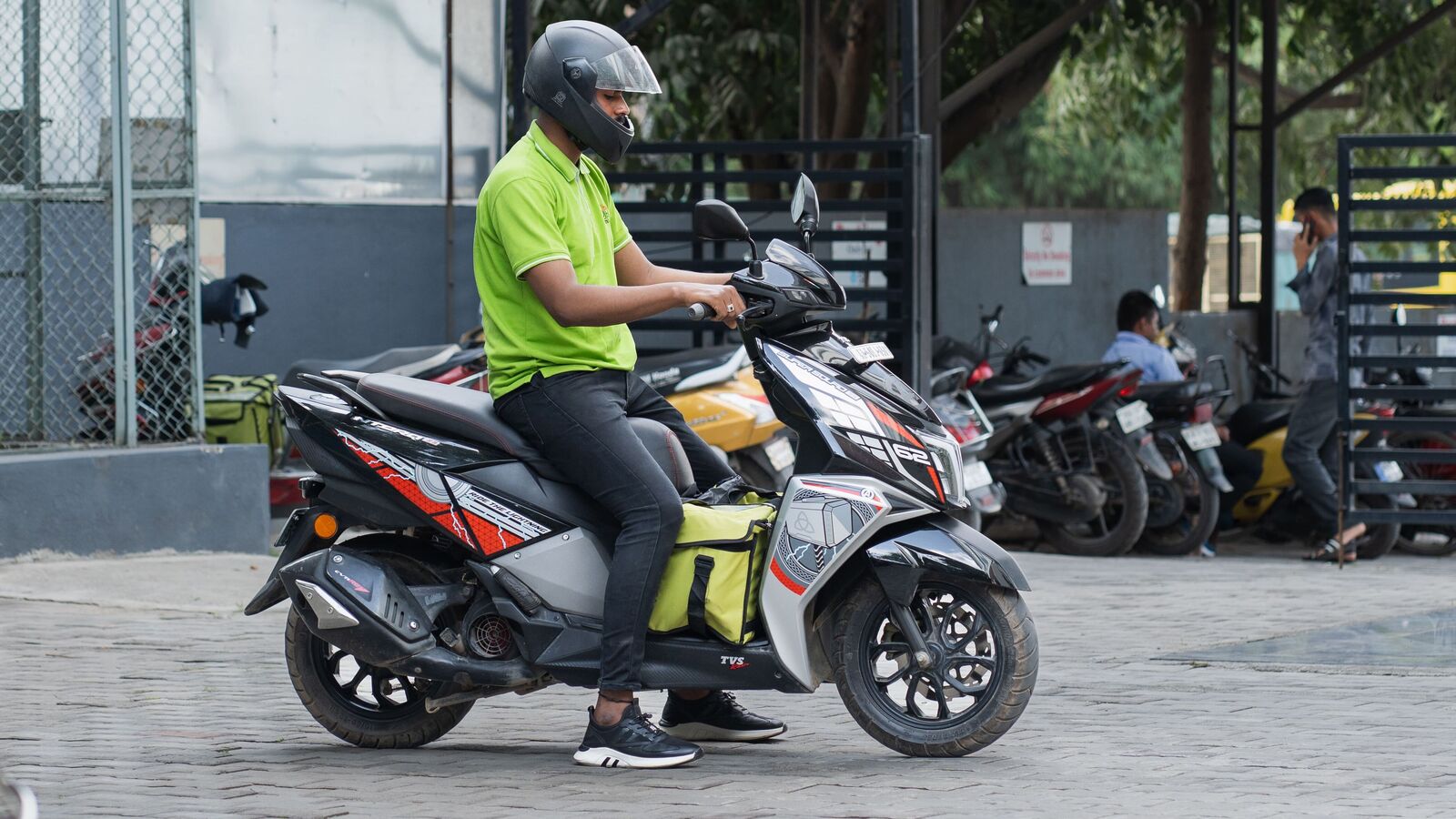
Companies like Instamart, Blinkit and Zepto that deliver grocery and other household essentials within minutes have expanded their network of dark stores – distribution centres set up in densely populated areas to fulfil online orders – in a bid to save costs and accelerate deliveries.
A surge in these dark stores is surely speeding up deliveries but shrinking rider paychecks, as shorter trips slash distance-linked incentives.
As a result, average per-order payouts to quick commerce riders have tumbled, and delivery workers are now quitting platforms within 3–6 months of joining, say industry experts.
“Store density has gone up, and, hence longer distance orders aren’t in the picture anymore,” said Kartik Narayan, chief executive officer at staffing firm TeamLease Services Ltd.
As the dark-store density has increased, the delivery guys are expected to collect multiple customer orders, which means they typically have to stop at several hubs to pick up the ordered goods, before starting the delivery. So, while the distance may have shrunk, the time taken to complete deliveries has risen, hurting riders financially.
Payouts and multiple stops
Delivery workers typically get a minimum pay per order ( ₹12– ₹20 for short trips of around 1 km), which is topped up by distance-linked bonuses, peak-hour surges, or weather fees, boosting their income.
“The more colourful your order is—that is, the more variety of items it has—the higher the chance we’ll need to stop at multiple hubs to collect them. That adds extra time and effort before we can even start the delivery,” said Ankur, a 22 year-old Blinkit delivery worker in Mumbai.
“The closer the hub is to you, the distance decreases, but we might have to stop at multiple hubs for batching. That means we end up riding all day for the same money or less,” said Ranjan, a 26-year old Swiggy Instamart delivery worker in Delhi, adding that it’s “pretty much the same across all three platforms.”
Queries sent to Swiggy, Zomato, and Zepto did not elicit a response till press time.
Expansion and store density
Swiggy’s quick-commerce arm Instamart added 498 dark stores in FY25—nearly matching its total openings over the previous four years. Its network has ballooned to 1,021 stores and four million sq ft of space, a 2.6× jump fuelled by larger-format facilities and store expansions.
It also added 44 megapods — large dark stores, each measuring 10,000–12,000 sq ft— in metro cities capable of storing 50,000 SKUs (stock-keeping units), offering customers a much wider range of products to choose from. However, it has paused its dark-store expansion since the March quarter.
Zomato’s quick commerce arm, Blinkit, grew aggressively in FY25, boosting its store count 147% year-on-year to 1,301 and expanding its warehousing footprint to 5.2 million sq. ft. Eternal Ltd’s unit remains in growth mode, targeting 2,000 stores by December, while Zepto has paused expansion after hitting about 1,000 stores.
Impact on trips, bonuses
“As dark stores have moved closer to customers, average metro trip lengths have fallen by 20–30% over the past year, meaning fewer orders now qualify for these bonuses,” said Nilaya Varma, co-founder at Primus Partners, a management consultancy firm in Delhi.
Platforms may need consistently high batching rates – meaning more orders per ride – or a fixed-pay guarantee to maintain rider incomes, as the current model risks leading to more frequent but lower-value trips and higher churn in metro markets, said Varma.
“I used to do food delivery with three to four long-distance orders in a shift. When Blinkit came, I switched, thinking more quick orders would mean more money. But the pay per trip has dropped—from about ₹30– ₹45 when I started last year to ₹20– ₹25 now—so it’s more trips, more fuel, but less money,” said Rakesh, a 36-year-old Blinkit delivery worker in Delhi.
Quick commerce’s strategy to blanket neighbourhoods with multiple dark stores may not be paying off as expected, particularly in top cities. There is a significant shortage of delivery workers in urban centres like Bengaluru and Delhi. Vacancy rates at platforms like Blinkit, Instamart, and Zepto have surged to as high as 30% in some cities, especially where new stores are expanding rapidly, industry experts said.
Attrition, worker shortage
“Average rider tenure in metros has dropped from 4–6 months to 3–4 months in a year. This churn means platforms have to spend more upfront on hiring and training new riders, which reduces the cost savings they were aiming for with denser networks,” said Varma.
Quick commerce faces far higher attrition than traditional e-commerce and logistics, as many delivery workers move to jobs with steadier hourly pay, like e-commerce last mile or food delivery with larger delivery radii.
For Eternal, over the past five quarters, the average number of monthly active delivery partners has remained in a narrow range, starting at 469,000 in Q1FY25 and rising to 509,000 in Q1FY26. The quarterly figures were: 498,000 in Q2FY25, 480,000 in Q3FY25, and 444,000 in Q4FY25.
In Q4FY25, Eternal founder and chief executive Deepinder Goyal had flagged a shortage of last-mile workers as a key reason for a slowdown in its food delivery business.
However, company CFO Akshant Goyal said during the Q1FY26 earnings call that “Utilization — or rather, the idle time of delivery partners on the platform — continues to come down. As that happens, we’re able to do more orders with the same number of log-in hours. It’s actually a good thing because it makes our business more efficient while, at the same time, it increases the earnings of delivery partners.”
Swiggy had an average of 515,000 monthly delivery partners in FY25, according to its annual report.
Revisiting pay structures
As disillusionment mounts and riders quit, companies are revisiting pay structures and considering adding a base-pay component to stem the attrition and stabilise their delivery fleets.
“Some platforms are experimenting with base pay structures, insurance, and added benefits. However, the reliance on per-order incentives remains high, and wage guarantees are still limited, leaving workers vulnerable to the ongoing fluctuations,” said Deepesh Gupta, director and head of general staffing, Adecco India.
“They’ll add a ₹15 rain fee, but it’s not enough to cover the drop in per-order payouts,” said Ankur, the Blinkit delivery worker in Mumbai.
For context, Blinkit employs a structured rate card where delivery partners receive a base pay of ₹15 per trip (for up to 1 km) and an additional ₹10–14 per km for distances beyond 1 km. In some markets, rates vary— ₹9–12/km with occasional bonuses up to ₹15/km, but without a guaranteed base pay, leading to deep pay cuts and protests, according to media reports.
Zepto uses a tiered performance model—‘Zepto Star’ ranks—and offers a fixed per-kilometer rate for deliveries, with a lower rate for return trips, though exact figures aren’t publicly disclosed; distance remains a clearly formalized component of earnings.
Swiggy Instamart offers distance-related incentives in the form of surge pay and peak-hour bonuses, with base pay and variable components, but publicly available breakdowns of per-km compensation are limited.
Platforms have adopted a tiered payout system tailored around distance and weather conditions. “For short trips spanning 1–2 km, delivery partners earn between ₹12 and ₹25 per order. As the distance extends to 3–4 km, payouts can reach up to ₹40. Rainy days add an extra ₹15, motivating riders to brave the weather, but overall, the incentives are gradually shrinking,” said Gupta.
Moreover, per-order payouts have fallen sharply—from ₹30– ₹40 in 2024 to ₹12– ₹25 in 2025—with occasional bonuses attempting to cushion the blow but not fully reversing the trend, said Gupta.