




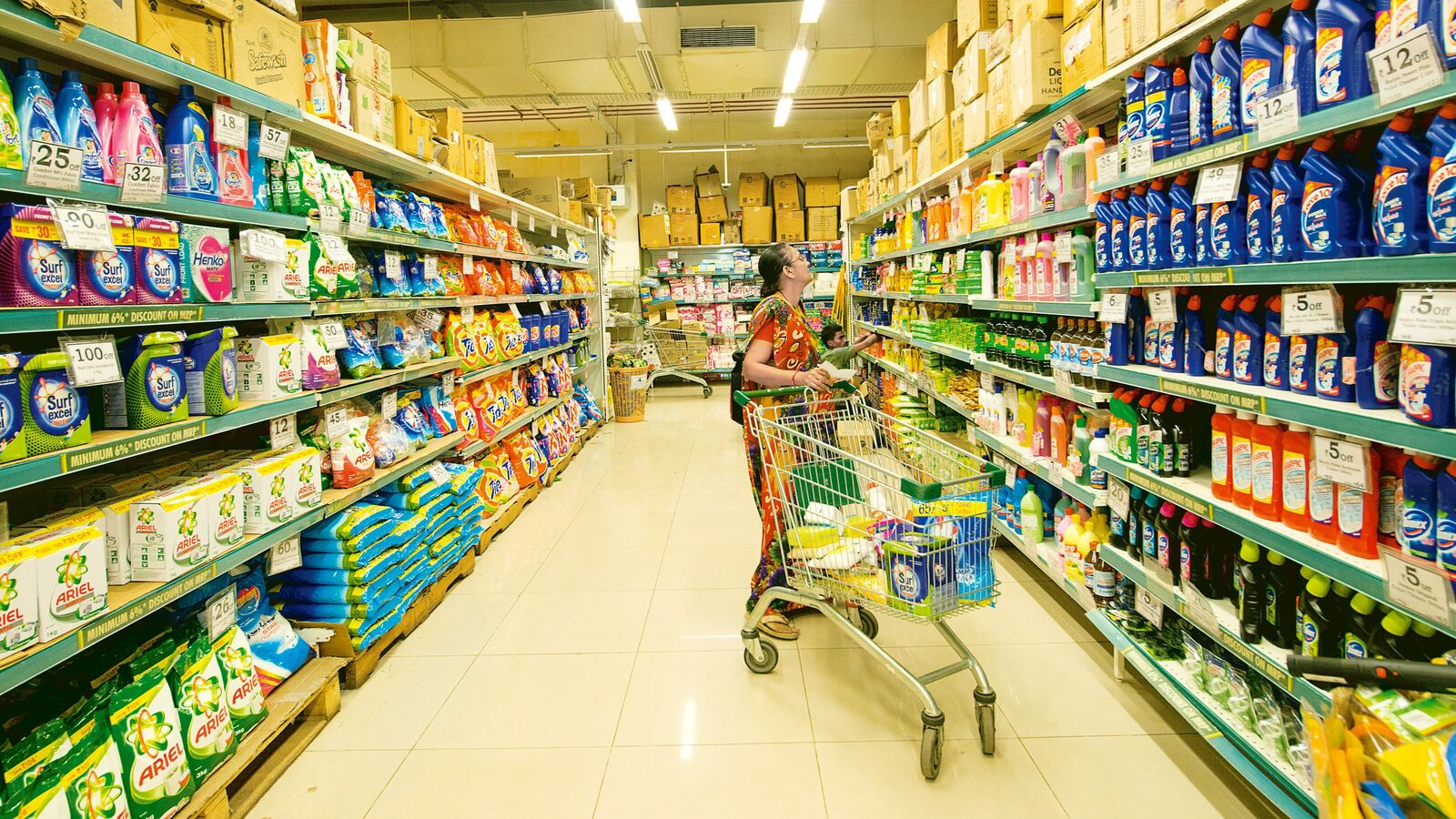
Walk into a grocery or apparel chain, and chances are you’ll spot these emerging labels on top shelves, beaming right alongside established fast-moving consumer goods (FMCG) brands.
Direct-to-consumer brands are companies that sell products directly to shoppers without relying solely on traditional distributors. Unlike legacy FMCG giants, which depend on decades-old networks, most D2C startups launch online before expanding into offline modern trade.
Avenue Supermarts Ltd, which operates DMart, the largest retail chain in the country by revenue, places new-age brands on the top shelves of all product categories. It’s easy to find large value packs of the brand Yoga Bar in the instant oats category placed next to well-known labels such as Quaker Oats and Nutridelite. In the nuts and dry fruits section, one would find packets of Happilo stacked up across all racks. Same goes for personal care products such as Pilgrim, and Derma Co, which were once available only online, are now present in some of the largest retail chains.
While Vishal Megmart does not follow this trend, retailers such as More Retail Ltd, Nature’s Basket by Spencers Retail Ltd, and Reliance Fresh have a wider assortment of new-age brands across various product categories featured on their shelves.
Neville Noronha, chief executive officer (CEO) of DMart, in a recent call with analysts, acknowledged this trend, and the retailer’s increasing interest in onboarding more new-age brands across its various product categories.
“D2C brands are doing a significantly better job in innovation-led opportunities compared to incumbent large FMCG,” Noronha said on 30 July in a post-earnings interaction. He cited the example of liquid detergents, where smaller players disrupted multinationals by creating mid-tier products and lowering costs for consumers.
To ease the entry of such brands, DMart has introduced a “Tuesday walk-in” policy, allowing vendors to pitch their products without prior appointments, provided they meet revenue thresholds of ₹50–100 crore.
Retailers are keen to get these brands on their shelves as they cater to a customer base different from mainstream FMCG brands.
“Many of these brands are very creative. They are very new. They meet some needs of consumers that the large brands are not able to do,” said Arvind Singhal, managing director of The Knowledge Company, a consulting firm.
The fact that these smaller brands offer better margins than large FMCG firms, which have a better negotiating ability, further strengthens their case.
“These brands are willing to give, therefore, more margin to the retailer as well,” Singhal said. “So it is a win-win. The brands get physical exposure, the retailer gets products that the mainstream companies are not able to give, and the customer segments end up buying some of these new products. Consumers are happy. Retailers are happy. The brands are happy.”
The brand story
For Perfora, a Bengaluru-based oral care startup, moving offline was almost inevitable, its co-founder Jatan Bawa said. After beginning as a pure D2C brand, Perfora is now present in large-format retailers, where sales traction is slower than e-commerce but strategically important.
“Oral care is usually a part of your monthly grocery basket. People are hesitant to shop for it online,” he said.
Bawa admitted the higher visibility costs and margin pressures from venturing offline compared to its direct-to-consumer model, but he sees offline expansion as key to building credibility and pushing larger FMCG players to innovate.
“Offline is a much longer-term game. Making your product available on the shelf is just step one,” he said.
Deep Bajaj, the founder of Delhi-based feminine hygiene D2C brand Sirona, concurred. While retailers like DMart demand steep discounts due to their volume-driven model, the trade-off is worth it as consumers increasingly expect to find innovative hygiene products in their neighborhood store, he said.
“Unless we’re in offline retail, we can’t complete the circle in the consumer’s life. She’s shopping online, I’m available; she’s going offline, I should be there,” Bajaj said.
The surge in D2C brands is being driven by growth in both online and physical stores. According to Redseer Consulting, dated 3 October 2024, India’s online beverage powders and syrups market, spanning coffee, tea, and health drinks, has risen from ₹1,200 crore in 2021 to ₹3,500 crore by 2024, at a 42% compound annual growth rate. D2C brands now account for a third of online coffee sales, and of the top 20 top performing beverage brands, 80% are D2C, having grabbed 5–6% share from legacy players in just a year.
The rapid rise of digital-first brands has forced FMCG incumbents to rethink innovation. “Large companies are not able to innovate as quickly as startups can,” said Singhal, adding that rigid internal processes have slowed them down.
To plug this gap, many FMCG companies have gone on an acquisition spree. Hindustan Unilever acquired a 90.5% stake in skincare brand Minimalist for ₹2,706.44 crore in January 2025, while Marico picked up 58% of nutrition label Plix for ₹369 crore in July 2023. ITC, too, began buying into Yoga Bar in 2023 with a ₹175-crore investment, and is on track to take full ownership by 2025. More than 20 D2C brands have been acquired by legacy players over the past five years, underscoring how incumbents view the shift in consumer demand.
“Many so-called new-age brands are pretenders, surviving on discounts and investor money,” said Devangshu Dutta, founder chief executive of consulting firm Third Eyesight. “Once the funding tap dries up, only products that truly resonate with consumers will sustain.”
Plum, a Mumbai-based clean beauty and skincare startup founded in 2014, has its products stocked across Reliance Smart, More Retail, Apollo Pharmacy, and Metro Cash & Carry.
“In offline, the product has to speak for itself; customers must pick a Plum face wash when there are literally 25 others on the shelf,” said founder Shankar Prasad. Modern trade contributes high single digits to Plum’s revenue and is growing steadily, with offline presence now seen as critical for brand discovery.
With contribution and assistance from Sowmya Ramasubramanian.