




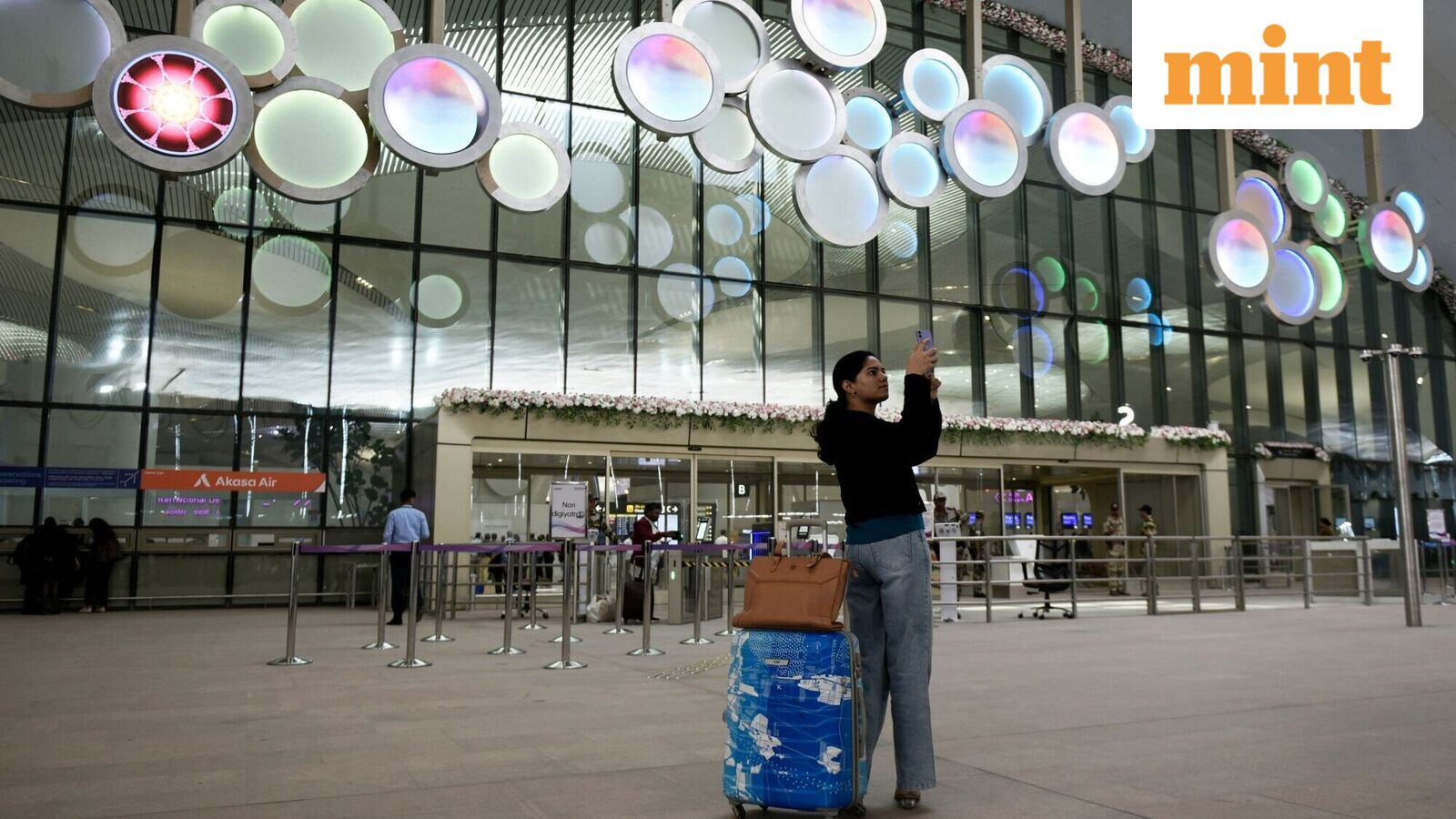
The development assumes significance as billionaire Gautam Adani’s newest airport has been operating for over a month without network coverage from private telecom operators, causing persistent connectivity issues for passengers.
“Bharti Airtel has commenced signal testing at the airport NMIA to evaluate the viability of providing mobile network services,” said one of the people cited above. “NMIA has experienced that the test signals are working smoothly in various sections of the terminal where ‘Proof of Concept’ trials are underway. The airport will continue to monitor signal efficacy for a few more days.”
Meanwhile, Vodafone Idea has brought its testing equipment to the airport and is also expected to begin network signal trials, a second person said. Reliance Jio, however, has not yet started such testing.
While Airtel has started signal testing, passengers will be able to get the operator’s network only after both the telecom operator and the airport agree on commercial terms. Disagreements over pricing have been the key reason for delays in rolling out mobile connectivity from private operators at the airport.
Queries emailed to Bharti Airtel, Vodafone Idea, Reliance Jio and NMIA did not elicit any response till press time.
Pricing standoff
Telecom operators, represented by the Cellular Operators Association of India (COAI), have sought the government’s and the telecom regulator’s intervention to resolve the issue. They alleged that NMIA quoted “exorbitantly” high charges for laying mobile infrastructure inside the airport.
According to the operators, NMIA has sought about ₹92 lakh per month per operator—amounting to nearly ₹44.16 crore annually for four operators—to deploy network infrastructure and provide mobile connectivity. The Telecom Regulatory Authority of India (TRAI) is currently examining the pricing concerns faced by telecom companies at the Navi Mumbai airport.
The airport had also proposed reduced charges in line with pricing at Mumbai International Airport Ltd (MIAL), which is about ₹40 lakh per month. However, operators did not accept the proposal, arguing that the charges were not reasonable given the airport’s footfall, according to a telecom executive. At some other major airports, such as Delhi, operators pay around ₹10–12 lakh per month.
Beyond pricing, telecom operators have alleged that they were denied right of way (RoW) permissions for installing telecom infrastructure at the airport. NMIA, however, has said that RoW has never been denied to any telecom service provider.
To be sure, NMIA has deployed its own in-building solution as a neutral-host mobile network, allowing telecom operators to offer coverage through the airport’s indoor network instead of installing separate equipment.
Airtel’s Mittal weighs in
Last month, Sunil Bharti Mittal, founder and chairman of Bharti Enterprises, said the connectivity issue would be resolved.
“It is too much noise. I think it (the issue) will get settled down,” Mittal told CNBC-TV18 on the sidelines of the World Economic Forum in Davos. “In the end, customers have to be served everywhere. Under the Indian Telegraph Act—old 1856 and 2023 now—right of way access, provision of services to customers is a must. Equally, airport operators put up a lot of equipment; they need to be given compensation for their return. Some balance will come out.”
Mittal also flagged concerns around telecom infrastructure contracts in tunnels and metro systems, where third-party operators charge telecom companies steep fees after paying large franchise amounts.
“What does that mean—customers suffer because we cannot pay obnoxious right of way charges to the tunnels and to metros,” he said.
Passengers have faced similar connectivity issues on the Mumbai Metro Aqua Line, where operators have failed to agree on pricing.
Wi-Fi workaround
As pricing discussions continue, NMIA is offering Wi-Fi connectivity to travellers. Passengers can also access the mobile network of state-owned BSNL at the airport.
Mobile connectivity is available only outside the airport premises, including after aircraft land and passengers are deboarded via aerobridges or buses. Inside the terminal, mobile networks do not function, and volunteers are stationed to help passengers connect to Wi-Fi.
Signboards with instructions for accessing the Wi-Fi are placed across the terminal. In the basement, passengers must remain connected to Wi-Fi to book cabs for onward travel.
Airport footprint
NMIA is the eighth airport owned by Adani Airports Holding, a wholly owned subsidiary of Adani Enterprises.
India’s top three airlines—IndiGo, Air India Group’s Air India Express and Akasa Air—are currently operating flights from the airport. NMIA crossed 1 lakh passengers within the first 19 days of commercial operations, according to the latest update.
The airport business contributed 10% to Adani Enterprises’ total consolidated income and 21% of its Ebitda. Income from the airport business rose 27% to ₹8,062 crore in FY25.