




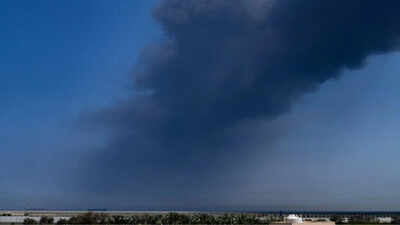
Ships are seen anchored near Fujairah port as smoke from burning oil facility fills the sky in Fujairah (AP photo)
An Indian-flagged crude tanker had a close call when the the UAE’s Fujairah port came under attack on Saturday while it was loading crude at the oil terminal. The vessel sailed out safely the next day with everyone onboard unhurt.The vessel, Jag Laadki, departed Fujairah at 10.30 am IST carrying around 80,800 tonnes of Murban crude oil and is now bound for India, according to the govt statement. Officials confirmed that the ship and all Indian seafarers on board are safe.“On March 14, 2026, while the Indian-flag vessel Jag Laadki was loading crude oil at the Fujairah Single Point Mooring, the Fujairah oil terminal was attacked. The vessel sailed safely from Fujairah at 1030 hrs IST today (Sunday) carrying about 80,800 tonnes of Murban crude oil and is bound for India,” the Ministry of Petroleum & Natural Gas said in a press release.“The vessel and all Indian seafarers onboard are safe,” it added.Jag Laadki is the fourth Indian-flagged vessel to emerge unharmed from the conflict-hit region. Its safe departure is considered significant as disruptions around the Strait of Hormuz have affected shipping movements and energy supplies in the region.Earlier on Saturday, two Indian-flag LPG carriers — Shivalik and Nanda Devi — successfully crossed the war-hit Strait of Hormuz while carrying a combined cargo of about 92,712 tonnes of liquefied petroleum gas (LPG). Shivalik is expected to reach Mundra port in Gujarat on March 16, while Nanda Devi is scheduled to dock at Kandla port a day later.Both ships were among 24 vessels that had remained stranded on the western side of the strait since hostilities began in the region. Another four ships had been stuck on the eastern side.One of those vessels, the Indian-flagged tanker Jag Prakash, crossed the strait on Friday after loading gasoline from Sohar port in Oman. It is currently heading to Tanga in Tanzania and is expected to arrive there on March 21.Authorities said Indian vessels and seafarers operating in the region remain safe, though the situation continues to be monitored closely. At present, 22 Indian-flagged vessels carrying 611 seafarers remain on the western side of the Persian Gulf region.India remains heavily dependent on energy imports, sourcing about 88 per cent of its crude oil, 50 per cent of its natural gas and 60 per cent of its LPG from overseas markets. Prior to the escalation of the conflict following the US-Israel strikes on Iran on February 28, more than half of India’s crude imports, along with around 30 per cent of gas and up to 90 per cent of LPG, came from Middle East countries such as Saudi Arabia and the UAE.The conflict has disrupted maritime traffic through the Strait of Hormuz, a critical route for global energy supplies. While India has partly offset crude supply disruptions by increasing purchases from countries including Russia, gas supplies to industrial users have been curtailed and LPG availability for commercial establishments such as hotels and restaurants has been reduced.The government said maritime authorities remain in constant coordination with stakeholders to ensure the safety of Indian seafarers.“The Directorate General of Shipping continues to monitor the situation in coordination with ship owners, RPSL agencies and Indian Missions,” the update said.It added that since the activation of the DG Shipping control room, authorities have handled 2,995 phone calls and more than 5,357 emails from seafarers, their families and other maritime stakeholders seeking information and assistance.So far, 276 Indian seafarers have been safely repatriated from the Gulf region, including 23 in the past 24 hours.Officials said ports across India are also keeping a close watch on vessel movements and cargo operations as the maritime situation evolves, while the Ministry of Shipping continues to coordinate with the Ministry of External Affairs, Indian missions and shipping companies to ensure the safety of Indian crews and the continuity of maritime trade.