




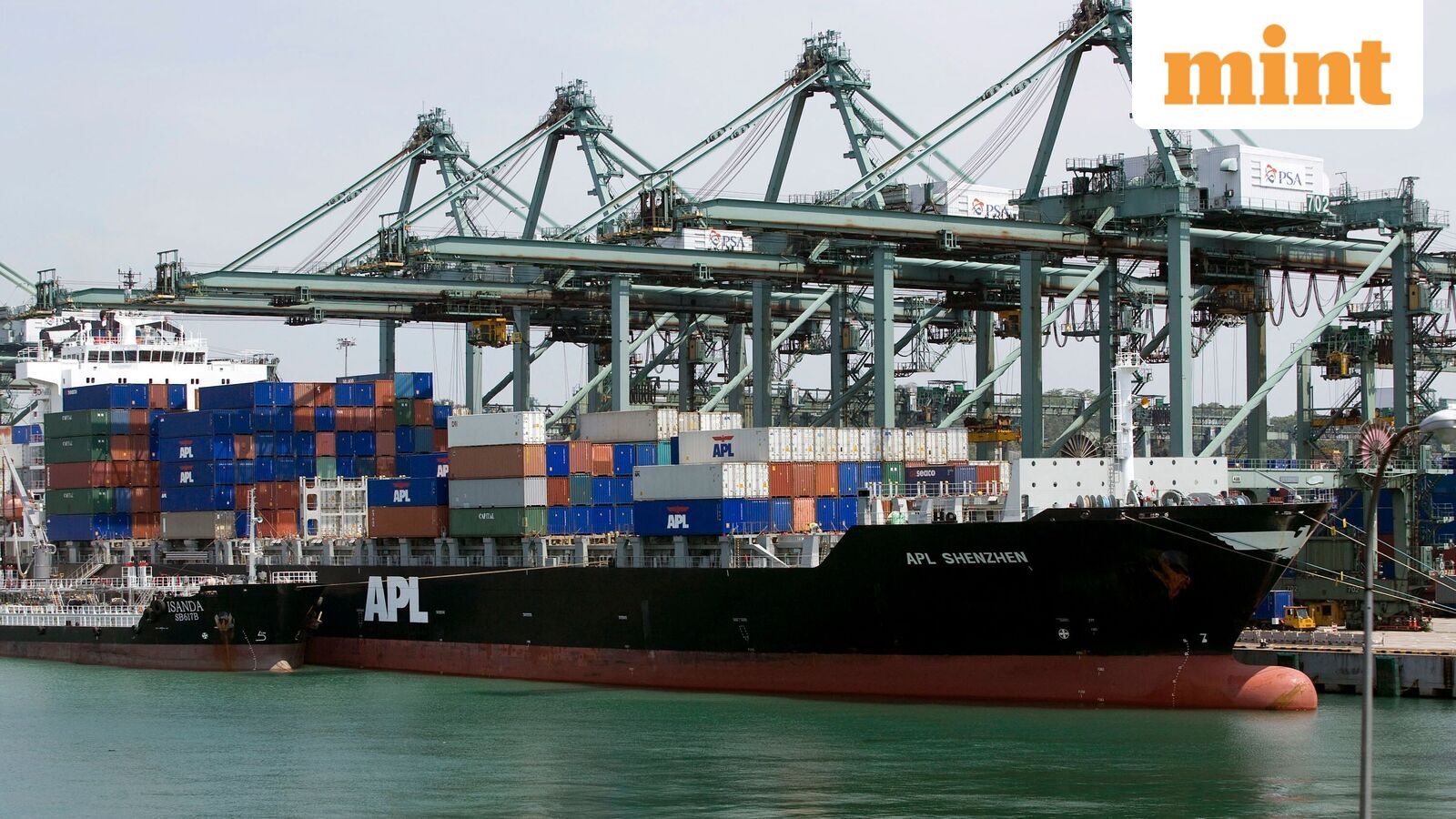
Several companies have expressed interest in manufacturing and demand aggregation for containers made in India, Sonowal, ports, shipping and waterways minister, said, citing names including the world’s largest container shipping line Mediterranean Shipping Company (MSC); second-placed and Danish giant A.P. Moller – Maersk and No. 3 and Marseille-based CMA CGM; along with domestic firms including JSW Group and Container Corp (Concor).
“We will facilitate them to invest in container manufacturing in the country,” he said in an interview with Mint.
The country aims to attract about ₹60,000 crore investments to build large-scale manufacturing capacity to build 750,000 units of 20-foot equivalent unit (TEU) dry cargo containers annually in the initial phase, he said. The country targets to ramp this up to over 7 million containers over the next decade.
India’s dependence on China for containers makes domestic trade vulnerable to global supply disruptions and price volatility, as seen during the pandemic. Official estimates suggest that the country imports nearly 2 million empty containers every year. Domestic capacity stands at 30,000 twenty-foot equivalent container units, compared to China’s six million units annually.
India’s push will be anchored by the ₹10,000-crore five-year container manufacturing programme announced in the Union Budget. This is an initial amount to push domestic manufacturing, he said, adding, “We would provide more funds, if required, as the goal is to take domestic capacity to meet at least 10% of the annual container demand.”
Queries emailed to MSC, CMA CGM and Maersk remained unanswered until press time. JSW and Concor also didn’t respond to queries.
The focus on developing domestic capability in construction and infrastructure equipment, and container manufacturing, is a positive move to address the vulnerability that supply-chain disruptions can pose to the country’s infrastructure and trade agenda, said Manish Sharma, sector leader–infrastructure, transport and logistics, PwC India.
Viability gap funding
The domestic container manufacturing would be supported through viability gap funding (VGF) from the ₹10,000 crore outlay, he said. “The support from the budgetary scheme will help Indian made containers to be cost-competitive. This will extend support to domestic maritime trade as well as provide an export market to Indian made containers.”
The government’s programme will support high-growth containerised cargo and generate a market value of ₹80,000 crore, creating 3,000 direct and 50,000 indirect jobs, he said. “This reduces reliance on 2 million imported empty containers annually and bolsters supply chains while fostering ancillary industries such as corner castings and paints.”
Sonowal’s ministry plans to leverage the budgetary support to prepare a 13-year roadmap with capital expenditure support for establishing new and expanded container manufacturing plants, as we as operating expenditure financial assistance to offset the cost gap with China.
60% local content
According to ministry documents, the container manufacturing scheme would have mandatory domestic content at 60% initially, which will go up to 80% by the end of the scheme. The manufacturing would also be supported through concessional land allotments near ports and maritime clusters. Demand aggregation would be pursued through long-term commitments from shipping lines such as MSC, CMA CGM, Maersk, Concor, Shipping Corp. of India (SCI) and Bharat Container Shipping Line (BCSL), the documents showed.
“Together, these interventions are designed to build a globally competitive ecosystem and position India as a reliable regional hub for container manufacturing,” said Sonowal.
Vivek Lohia, managing director, Jupiter Wagons Ltd, expects the ₹10,000 crore scheme to help build scale in domestic manufacturing. “As a company that has been at the forefront of container manufacturing, we see this as a boost which can significantly accelerate production capacity and localisation.”
According to Pragya Priyadarshini, managing director, Primus Partners, said apart from boosting self-reliance in line with the Atmanirbhar Bharat vision, greater domestic production will “stabilize container availability and reduce logistics costs, enhancing trade competitiveness”.
Expanding India-flagged fleet
Besides the push for container manufacturing, Sonowal said his ministry has facilitated the creation of Bharat Container Shipping Line, a joint venture anchored by the SCI, to accelerate the acquisition and ownership of Indian-flagged container vessels and reduce reliance on foreign shipping lines.
The proposed JV partners in the venture include SCI and Concor as anchor shareholders, with equity participation from Jawaharlal Nehru Port Authority (JNPA), V.O. Chidambaranar Port Authority and Chennai Port Authority. The remaining support is proposed through the Maritime Development Fund (MDF).
“BCSL is envisaged to develop a fleet of around 51 container vessels over the next two decades, with a targeted capacity of about 0.6 million TEUs by 2045, through a phased induction of fuel-efficient and dual-fuel ships,” the minister said.