




The comparison with March 2020 is inevitable because the bank, founded by now disgraced banker Rana Kapoor, was on the brink of collapse. The Reserve Bank of India (RBI) stitched together a rescue involving the State Bank of India (SBI), ICICI Bank Ltd, Kotak Mahindra Bank Ltd, among others. These lenders infused capital after the regulator superseded the board.
Late on Tuesday evening, Yes Bank told the exchanges that RBI has approved Tonse’s name as the next chief executive. Shares of the bank rose on Wednesday, following the news, ending the day’s trade at ₹21.52 apiece, up almost 1% from the previous close.
“Yes Bank’s history shows that growth was never the constraint, risk was,” analysts at Ventura Research said in a note on 9 January. “In its early years, the bank scaled rapidly through aggressive corporate lending, building size, but accumulating latent asset-quality risks that culminated in the FY19–20 crisis.”
Ventura Research said that the bank’s journey from elevated stress to one of the lowest net bad loan levels in the industry reflects a fundamentally altered credit culture. “The transition from aggressive growth to conservative underwriting, high provisioning, and focused recoveries demonstrates a root-to-branch transformation in asset quality management, rather than a mere cyclical clean-up,” it said.
Meanwhile, most banks divested their stakes after the three-year lock-in, but SBI remained invested, finally selling 13.2% in September 2025 to Japan’s Sumitomo Mitsui Banking Corp. (SMBC) for ₹8,889 crore. SBI still owns around 10.8% of the bank.
Former SBI chief financial officer Prashant Kumar, who came in as part of the change, stayed back after an extension last year. That allows him to retain the role for six months from 6 October, or until a successor is appointed.
Retail banking expert
Tonse, 60, a former SBI executive who last headed the retail banking division at the state-owned lender, gets a cleaner Yes Bank, devoid of most of its legacy issues. At SBI, he managed a retail book of nearly ₹16 trillion, over six times Yes Bank’s entire loan book.
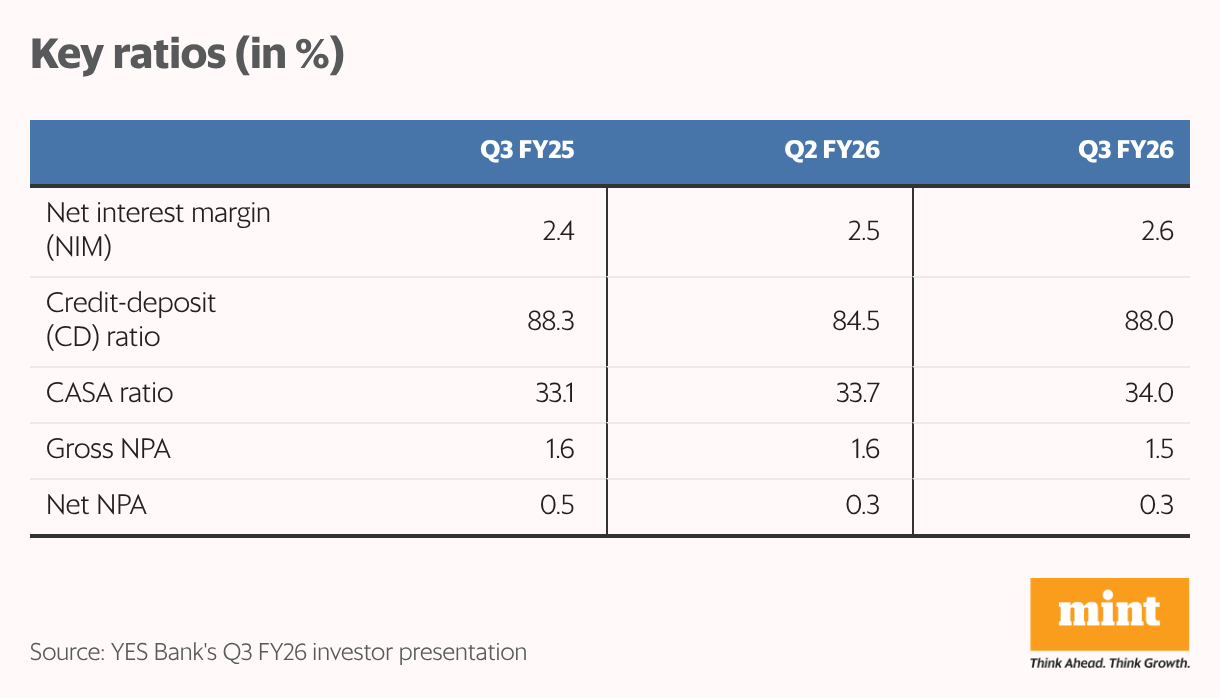
Yes Bank’s asset quality has substantially improved, with bad loans as a percentage of total loans at 1.5% at the end of December, down from the peak of 18.9% in December 2019. The share of low-cost deposits has improved to 34%, from 32.1% six years ago. The management also cleaned up the balance sheet by offloading ₹48,000 crore in stressed loans to J.C. Flowers Asset Reconstruction Co. in 2022.
Deposit challenge
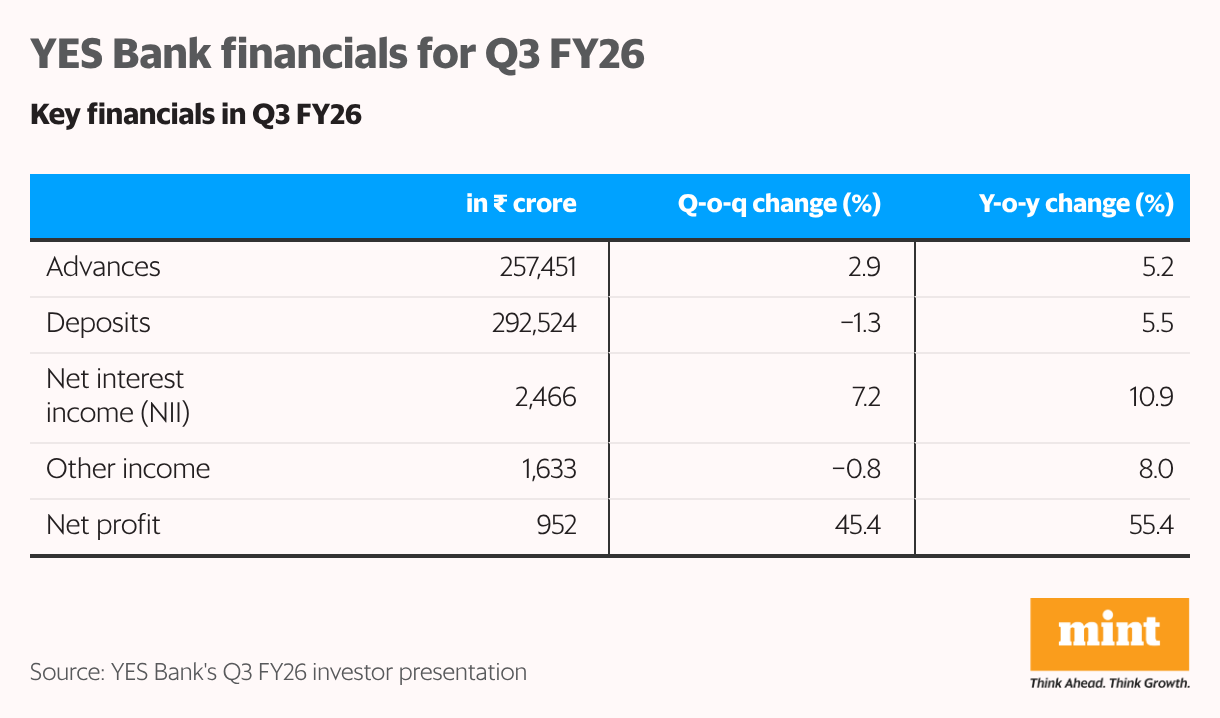
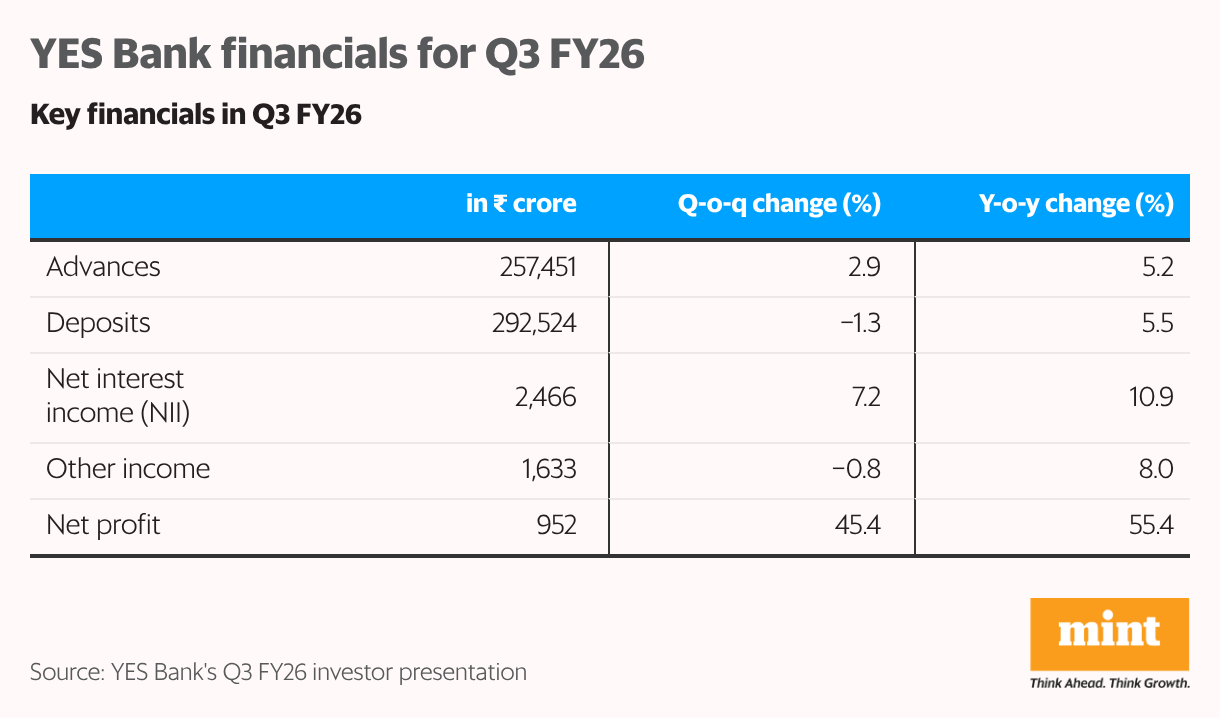
For Tonse, the challenge will be to shore up deposit growth, given the current environment. The bank reported a 5.5% year-on-year (y-o-y) growth in deposits to ₹2.9 trillion in Q3 of FY26, while peers like IDFC First Bank Ltd and Federal Bank Ltd reported 24% and 11.8%, respectively. The bank also lags peers in margins. Yes Bank’s net interest margin of 2.6% is lower than IDFC First Bank’s 5.7% and Federal Bank’s 3.18%.
Analysts are hopeful of better days ahead. Nomura expects return on assets to gradually improve to 0.9%- 1.1% by FY27/FY28, up from 0.8% in the first nine months of FY26, driven by improving margins, sustained momentum in fee income, and controlled credit costs.
“…a strong profitable turnaround in the retail segment holds the key, in our view,” analysts at Nomura said in a note after the bank’s earnings in January.
Yes Bank now has a capital cushion. Japanese lender SMBC bought 24.2% in two transactions. In January 2026, the central bank allowed SMBC to operate a wholly owned arm in India, four months after the Japanese financial services giant acquired the stake. SMBC currently operates in India in branch mode from its offices in New Delhi, Mumbai, Chennai, and Bengaluru.
In the bank’s Q3 media earnings call, Kumar said the bank’s board has begun succession planning for the top position and is expected to make a decision in the current quarter. The bank will also formulate a five-year strategy by next quarter, he said.
“If you see continuously, every quarter has been better than the previous quarter,” Kumar had said during the analyst call on 17 January, adding that the bank would still prefer to be very calibrated and cautious in its approach.