




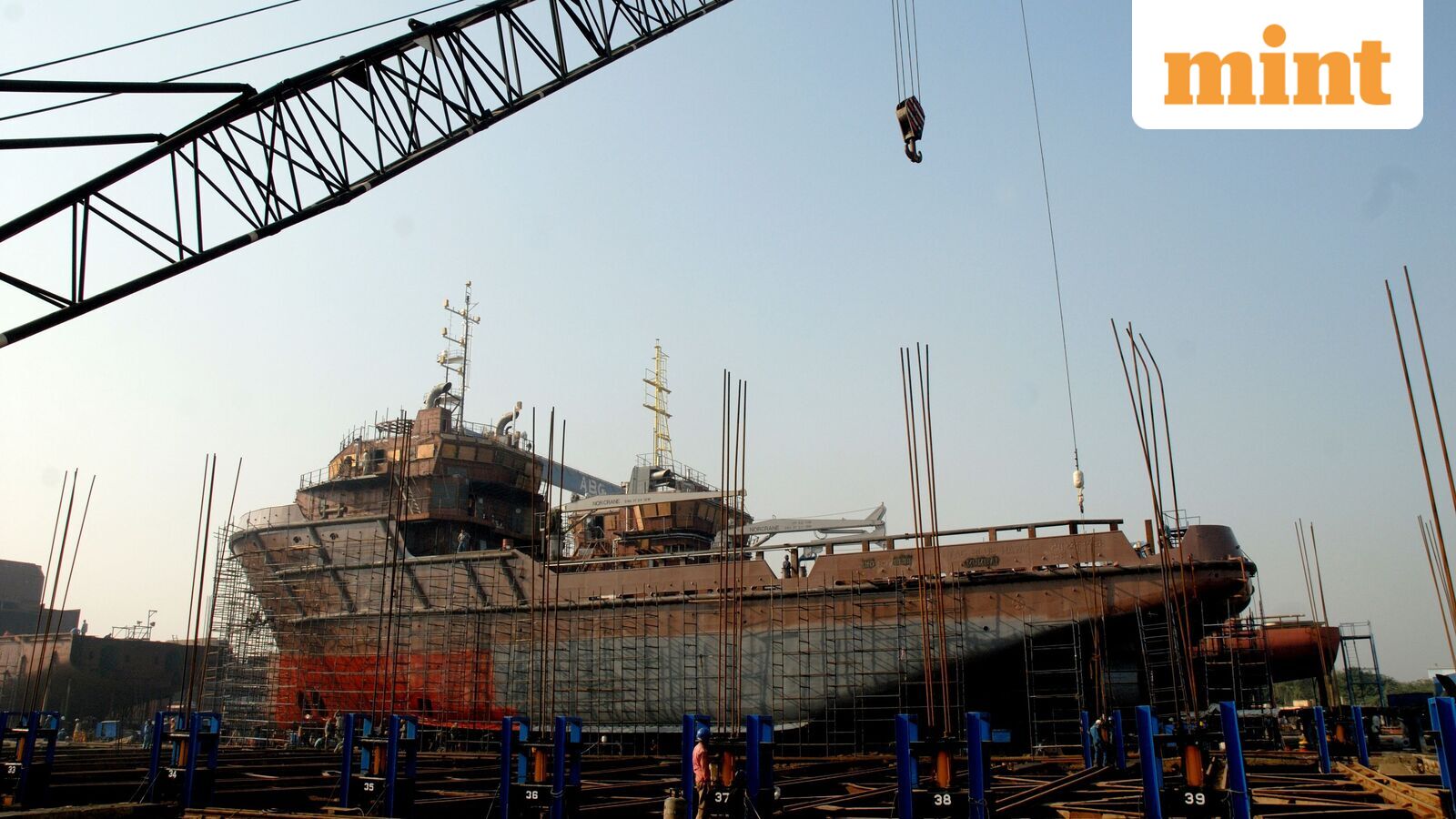
Indian Oil Corp. Ltd, Bharat Petroleum Corp. Ltd and Hindustan Petroleum Corp. Ltd are part of the discussions with South Korea’s HD Hyundai, Samsung Heavy Industries and Hanwha Ocean, the people said on the condition of anonymity, adding the new yard may come up in Andhra Pradesh. In September, the four state-run companies, which plan to acquire dozens of crude and gas carriers over the next decade, had decided to form a joint venture to procure such vessels.
“Along with the consideration to procure vessels produced by these shipmakers, SCI and oil companies would join a shipbuilding entity, possibly through a joint venture as equity partners and remain dedicated buyers for ships being made in India,” one of the three people said, adding this would provide assured demand for the yard and make investments financially viable earlier. Depending on the size and scale of the shipyard, investment can range widely between ₹1,500 crore and ₹15,000 crore.
Currently, Indian refiners charter foreign vessels for their requirements. However, an indigenous fleet is expected to provide support during times of turmoil, like the vessel scarcity that boosted freight rates in 2022. As India is one of the largest importers of energy, both crude and natural gas, supply chain issues may lead to a major impact on the economy and energy security.
An HD Hyundai spokesperson confirmed that the company was exploring various avenues of cooperation, but nothing has been finalized yet. “We signed a memorandum of understanding with Cochin Shipyard earlier this year in the commercial vessel sector and have since expanded discussions into naval vessels as well,” the spokesperson said, adding Indian officials had visited Hyundai’s offices where potential future cooperation was discussed.
Queries mailed to the ministries of petroleum and shipping, the state-run companies, Samsung and Hawnha Ocean remained unanswered.
While China is the world leader in shipbuilding, commanding about half of the global capacity, South Korea is the second-largest, accounting for 25-30%. India has negligible share of the global capacity.
The oil companies require about 112 ships over next five to 10 years, according to government estimates. Over five years, the refiners’ consortium plans to buy about 59, through second-hand purchases and newly built vessels, of various types such as very large crude carriers, very large gas carriers, Suezmax and Aframax tankers, medium range tankers, and offshore vessels, with an investment of as much as ₹7.15 trillion over the next five years.
Suezmax refers to the largest ships, primarily oil tankers, that can transit the Suez Canal fully loaded. Aframax tankers are mid-size tankers and the name comes from the Average Freight Rate Assessment (AFRA) system. Aframax tankers became popular because of the size constraints on large oil tankers in busy and congested sea routes.
Talks gained momentum after Union petroleum minister led a delegation to South Korea with industry executives during 13-15 November, where maritime cooperation was discussed. The minister informed Korean executives that the annual expenditure of $5-8 billion in energy freight by state-run companies in India presents an opportunity to develop such vessels locally.
A.K. Sharma, former director (finance) at Indian Oil Corp. said, “The initiative to own ships would help in self-sufficiency and at times of exigencies like sanctions on ships carrying Russian crude in the past few years. Indian refiners operating their own ships would ensure issues such as bans and sanctions on vessels do not have a major impact on supplies to India.”
Sharma, however, noted that in terms of operating cost, the expenses would not have a major difference compared to charter-hire of ships.
“Taking into account running cost and depreciation, there may not be a major difference in operating costs compared to hiring these vessels. But, the major benefit would be that owning vessels would allow refiners some sort of flexibility in terms of transport,” he added.
Gaurav Moda, partner and leader for energy at EY-Parthenon India said that given the expenditure on leasing and chartering vessels and the need for energy security, India should look at developing ships and oil and gas carrying vessels within the country.
India spends billions of dollars annually to charter ships, said Gaurav Moda, partner and leader for energy at EY-Parthenon India. “Therefore, it makes logical sense and it’s high time to evaluate charter versus build/ buy. Therefore, doing more of the build is in our economic and national interest towards energy security,” Moda said.
India is striving to become a manufacturing hub for ships. Recently, the government announced a ₹70,000 crore package to develop the maritime sector with a specific focus on shipbuilding.
Mint earlier reported that India is working on an ambitious plan to provide assured demand for ships built in the country from various state-owned entities and departments as it looks to incentivise investments in creating large shipbuilding facilities in the country and the ministry of ports, shipping and waterways (MoPSW) has asked the ministries of steel, chemicals and fertilisers, petroleum, coal, mines, commerce and textile to work on a plan for ship ownership by their respective state-run firms.
India’s push is driven by an aim to magnify its negligible share of global shipbuilding, currently below 1%. The Maritime India Vision 2030 and Vision 2047 plans aim to elevate India into the top 10 and then top five shipbuilding and ship-owning countries worldwide, respectively. The target is to raise the share of Indian-built ships in India’s fleet from the current 5% to 7% by 2030 and a substantial 69% by 2047.