




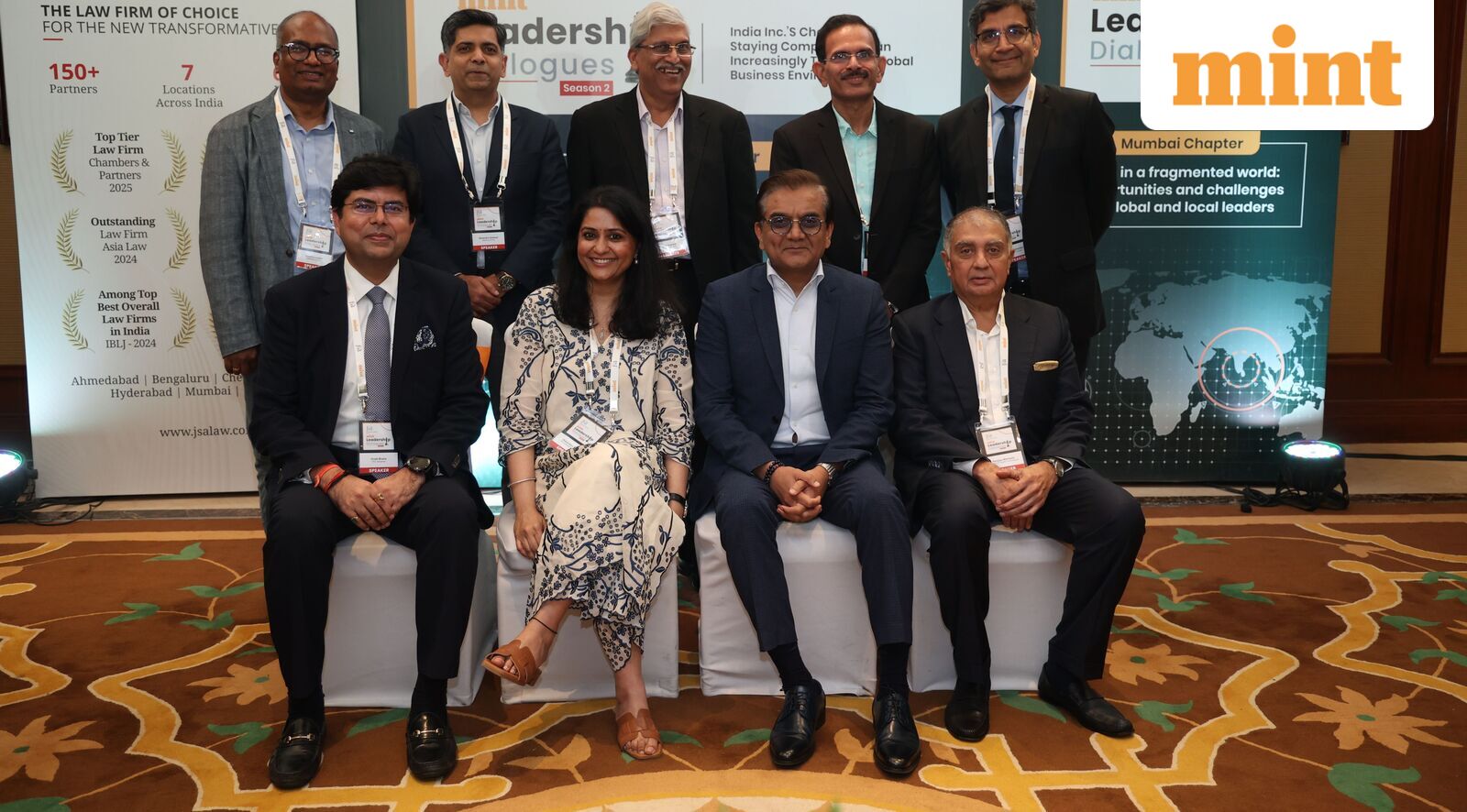
Sanjaya Mariwala, founder and executive chairman of Omni Active Health Technologies, opened with a reality check. “There is an expectation,” he said, “but I’m not sure if that’s really being met effectively.” Optimism, however, was hard to miss. Amit Paithankar, whole-time director & CEO of Waaree Energies, reminded the audience that India’s opportunity is not new. “It’s been an opportunity five years ago, ten years ago, thirty years ago. And it’s our time to seize it.”
Girish Tanti, co-founder and vice chairman of Suzlon Group, emphasized focus over geopolitics. “It’s a very dynamic world,” he said. “There are pockets of opportunity where we are well-placed, and others where we are at a disadvantage. The key is to sharpen our skills and be the best at what we do. The market will follow.” Tanti added that industries that think globally from the outset tend to outperform, even in sectors where India already has strong domestic demand.
The ecosystem gap
Narendra Ostawal, managing director at Warburg Pincus, pointed to a missing piece: ecosystem thinking. “The opportunity is there,” he said, “but our actions are still a little passive.” Mariwala agreed. “We need a determined strategy and ecosystem to make a dent in the world. It’s risky, but that’s what entrepreneurship is about.”
Nisha Kaur Uberoi, partner at JSA Advocates & Solicitors, highlighted regulatory friction. “Indian industry has created tremendous value, but last-mile execution matters. Desire is there, but frameworks and enablers need to catch up.”
“You cannot have policy and regulators which then cut Indian domestic champions down to size because then they’re never going to be able to compete globally,” Uberoi noted.
Hemant Ruia, country manager at DP World – India Subcontinent, noted success in sectors like electronics and renewables, crediting policies such as PLI (production-linked incentives). “Mr Tanti is a living example,” he said. Yet, Ostawal reminded listeners that some progress came from external pressures rather than homegrown initiative: “In electronics, much of it was a pull-push from the US, driven by necessity rather than India taking the lead proactively.”
Vivek Bhatia, managing director and chief executive officer (CEO) of TKIL Industries, emphasized focused strategy. “We are not now talking about general strokes—let’s increase exports. We are talking about—let’s take this sector, what are the three or four hindrances, let’s fix that, let’s become a global champion in that, and then go to the next one. That’s a big shift that we have seen.” His point highlighted India’s move from broad policy ambition to targeted, actionable interventions.
Thinking global, acting local
India’s domestic market is both a blessing and a curse, the leaders agreed. Siva Ganapathi, vice chairman and managing director of Gokaldas Exports, said, “China dominates entire value chains and plays to scale. We may dominate parts of manufacturing, but often we don’t have the full ecosystem. We need global-scale thinking.” Tanti warned that a thriving local market can limit ambition. “If you design only for India, you limit your thought process. Success comes when you design for the world.”
Vimal Kejriwal, managing director & CEO of KEC International, highlighted a new opening. “Instead of saying China plus one, we are looking at — who else instead of China. Because of whatever is happening on the geopolitical side or polarization, in many places, people are now not wanting China. So that’s where you can also play your game, especially for us in the construction industry or EPC.”
Kejriwal further pointed out that the US does not want infrastructure to be built by the Chinese. “So that to me is a significant opening,” he added.
Ruia of DP World pointed to intellectual property as a lever for scale. “China shows that owning IP allows global reach. India can learn from that.” Tanti added, “China’s pre-covid advantage was cost. Now it’s innovation plus cost. That’s the mindset India needs.”
The arsenal of India
Paithankar expanded the view. “We have 1.4 billion people. Europe is slowing. Africa is still coming of age. Southeast Asia is fragmented. The three solid markets are India, China, and the US. India offers demand, talent, and resources. We can be kingmakers, if not kings.”
Mariwala drew lessons from China’s ecosystem play. “Target industries, build the supply chain, make it easy for businesses to operate, and encourage innovation. India needs a systemic approach.” He also stressed that India must focus on developing clusters of excellence, combining manufacturing, R&D, and logistics into coherent hubs.
Bhatia highlighted the education angle. “For exponential growth, you need innovation. But India keeps looking for Arjuns—the innovators—without investing in Dronacharyas—the educators who create talent. China systematically sent students abroad and ensured they returned. India needs a pipeline strategy.”
Pockets of progress and remaining gaps
The discussion acknowledged sectors where India is gaining traction. Electronics, renewables, pharma, textiles, and IT were cited as success stories. Yet leaders emphasized that scale, integration, and ecosystem thinking remain crucial. Bhatia noted, “Factor-based growth is linear. Innovation-based growth is exponential. That’s what India must pursue.”
Siva Ganapathi stressed that policy should support large enterprises to compete globally. “Eventually, it will be the big players who dominate exports. China’s capacities are humongous. India needs to adopt similar strategic thinking.” Tanti returned to the theme of global mindset. “Industries that start by thinking globally, not just for India, see success. The key is excellence. Innovation must be homegrown where possible. That mindset changes outcomes.”
The road ahead
The tone was optimistic. Tanti said, “India is uniquely placed. The glass is more than half full. We have a thriving domestic market and cultural strengths. Global investors are pouring in. Young people can take on big challenges. The key is to aim for excellence and global competitiveness. Don’t settle for second best.”
The dialogue underlined that India’s moment is real but requires focus. Ecosystem creation, global-scale thinking, innovation, and last-mile implementation are critical. India has the talent, capital, and market—but translating that into global impact will take strategic coordination between industry, policymakers, and investors.
From energy to electronics, construction to pharmaceuticals, India has shown glimpses of world-class capability. The challenge now is scale, integration, and execution. Leaders emphasized that deliberate action, not aspiration alone, will determine global success.
As the discussion weaved from speaker to speaker, one thought lingered: India is not yet a global superpower, but it is poised to become a kingmaker. Its decisions over the next decade will shape supply chains, markets, and innovation worldwide. The question is no longer whether India can compete with China, but whether it will think, act, and innovate at a global level.