




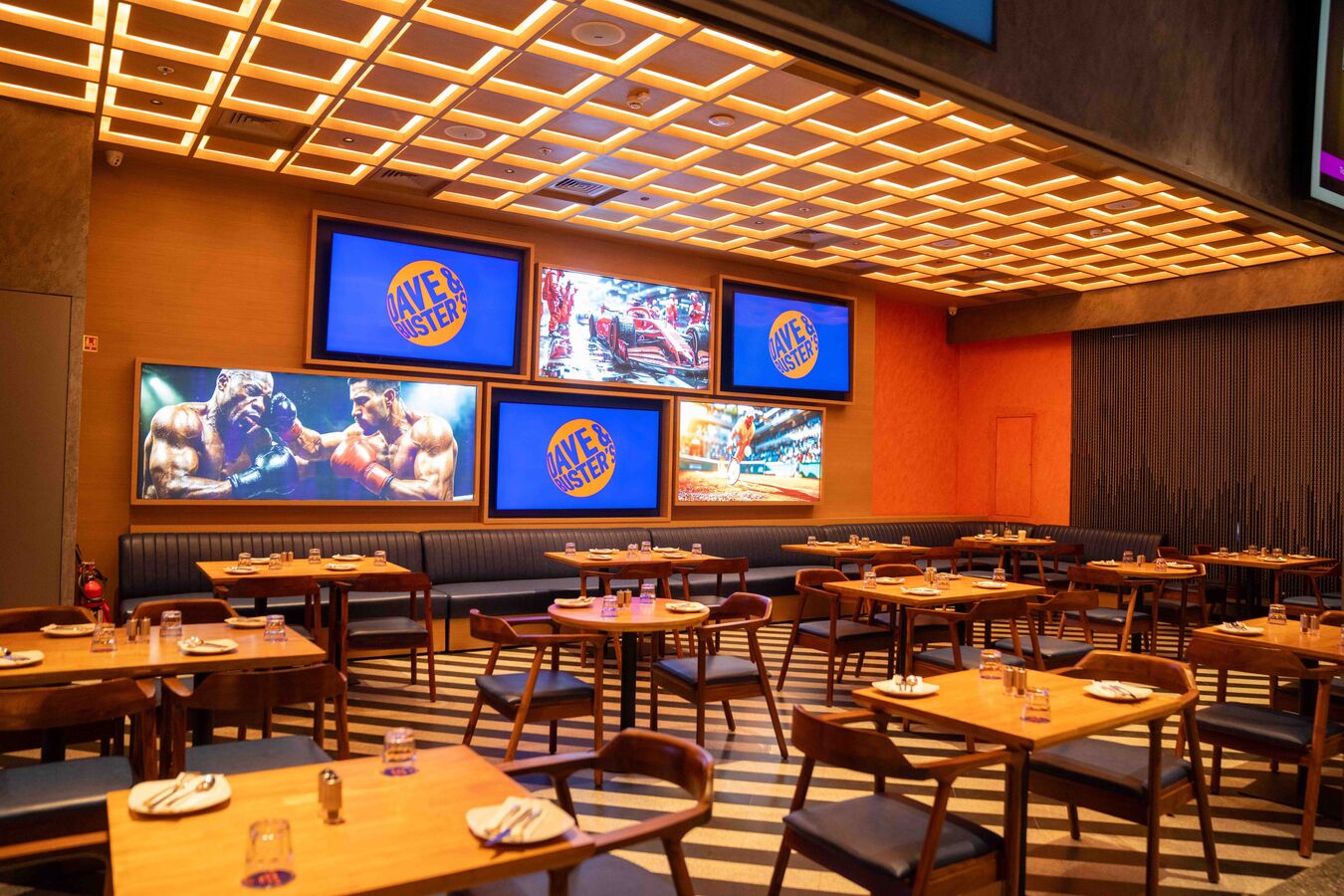
The company has an exclusive franchise partnership with the Malpani Group, the owners of the theme park Imagica, to expand to 15 stores over the next five to seven years. This expansion will focus on tier-1 cities before moving to tier-2 markets.
Antonio Bautista, chief international development officer at Dave & Buster’s, said India was a “priority global market” given its economic growth trajectory.
“India is probably one of the most important markets in the world today… It was just a matter of finding the right partner. When we met the Malpani Group, we knew we were in good hands,” he toldMint.
Each Dave & Buster’s outlet will be a large-format destination with a “sweet spot” of about 18,000 square feet, combining the brand’s four-pillar concept of eat, drink, play and watch. Bengaluru’s outlet spans 27,000 sq. ft, while the newly opened Mumbai store is 22,000 sq. ft.
“Finding the right space is one of the biggest challenges in India,” said Shreya Malpani, a director at the Malpani Group. “We look for a single-floor plate, good ceiling height and a strong catchment area.”
The investment per store will range from $2 to 4 million, she said, depending on location and format, with a breakeven period of three to four years. While the company is open to slightly smaller outlets to secure prime locations, it also plans to scale up for bigger opportunities.
The Mumbai outlet features India’s first nitro-lighting bowling with Spark Technology, a dedicated DJ stage, curated arcade games and a menu with 30-40% localisation, including dishes catering to Maharashtrian tastes.
Dave & Buster’s operates 176 outlets in the US and Canada and is now expanding to Mexico, Australia, the Philippines and the Dominican Republic. The company, based in Coppell, Texas, reported revenue of $2.1 billion in the fiscal year ended 4 February 2025.
Entrenched rivals
Dave & Buster’s entry comes as India’s indoor entertainment sector — pegged at over ₹4,500 crore and dominated by established players — expands rapidly. Timezone, part of The Entertainment and Education Group (TEEG), has been in India for almost two decades and operates more than 60 outlets across metros and tier-2 cities, investing over ₹100 crore annually in expansion.
Its formats range from 5,000 sq. ft compact centres in tier-2 malls to 25,000 sq. ft flagship spaces, with a mix of arcade games, bowling, VR zones, and prize counters.
Smaaash has rebuilt its presence post-pandemic with a focus on sports simulation and arcade attractions. Several regional players and mall-based gaming zones also compete for footfalls in the segment.
Bautista said Dave & Buster’s differentiation lies in delivering all four elements – food, drinks, games and live sports – at scale.
“Most competitors may do one or two well, but we’ve spent 40 years perfecting all four,” he said.
Another differentiator, Malpani added, is the ability to appeal to both young adults and families.
“You can come here for a corporate team-building event, a family day out or a night out with friends, all in the same venue,” she said.
Premium experiences
Malpani said India’s indoor entertainment sector is still in its early stages, particularly outside the metros.
“In tier-2 markets, there is disposable income but very few avenues for high-quality entertainment. There’s a large aspirational audience,” she said.
Bautista added that rising middle-class incomes are driving spending on leisure.
“Even if 10% of the population is our potential audience, that’s already bigger than many countries. Entertainment spend is growing at double-digit rates annually and that trend will continue for the next decade or more,” he said.
In India, the average spend is pegged at ₹3,000-4,000 per visit. Pricing is decided jointly, with the local partner providing market insights.
Customers top up a rechargeable card for arcade games, while bowling is charged separately. A loyalty programme is in the works, drawing on learnings from the US model, which uses customer data to personalise promotions.
Game selection is tailored to local preferences. While some games are proprietary or have temporary exclusivity, Bautista said the “secret sauce” lies in how they are laid out, priced and integrated with the F&B experience. Equipment for India is sourced from the US and Europe.
Partnership model
Outside the US and Canada, where it operates company-owned outlets, Dave & Buster’s uses a master franchise model, typically with one franchisee per country. The Malpani Group partnership covers all of India.
Bautista said the group was an “ideal” partner, with experience in hospitality and entertainment, strong financial capability and cultural alignment. Talks began in late 2022, with the agreement signed in mid-2023, the Bengaluru location finalised in early 2024 and operations starting in December.
While the initial plan is 15 outlets in 5-7 years, both partners indicated the potential to go beyond that.
“This is not just about hitting a number – it’s about creating a legacy,” Bautista said. “There’s a saying from Mr. Ratan Tata that I use — if you want to go fast, go alone; if you want to go far, go together. We want to go far, and we want to go together.”