



India has traditionally relied on oil from West Asia, until Russia began offering steep discounts three years ago. Saudi Aramco and Abu Dhabi National Oil Co., the oil champions of Saudi Arabia and the UAE, are among West Asia’s top crude oil producers and suppliers.
“Import of Russian oil will continue, but India is also looking at diversifying its imports, and higher supplies from West Asia are being looked at,” one of the two people cited above said.
Queries sent to the Union petroleum ministry, Indian Oil Corp. Ltd, Bharat Petroleum Corp. Ltd and Hindustan Petroleum Corp. Ltd remained unanswered.
Moscow calling
As European countries shunned Russian oil in the wake of the Ukraine war, India stepped into the breach, scooping it up at a steep discount. The discount has sharply narrowed now, and India’s Russian oil imports have fallen as well. Currently, Russia caters to 36% of India’s total oil imports, compared to 2.5% before Russia invaded Ukraine in February 2022.
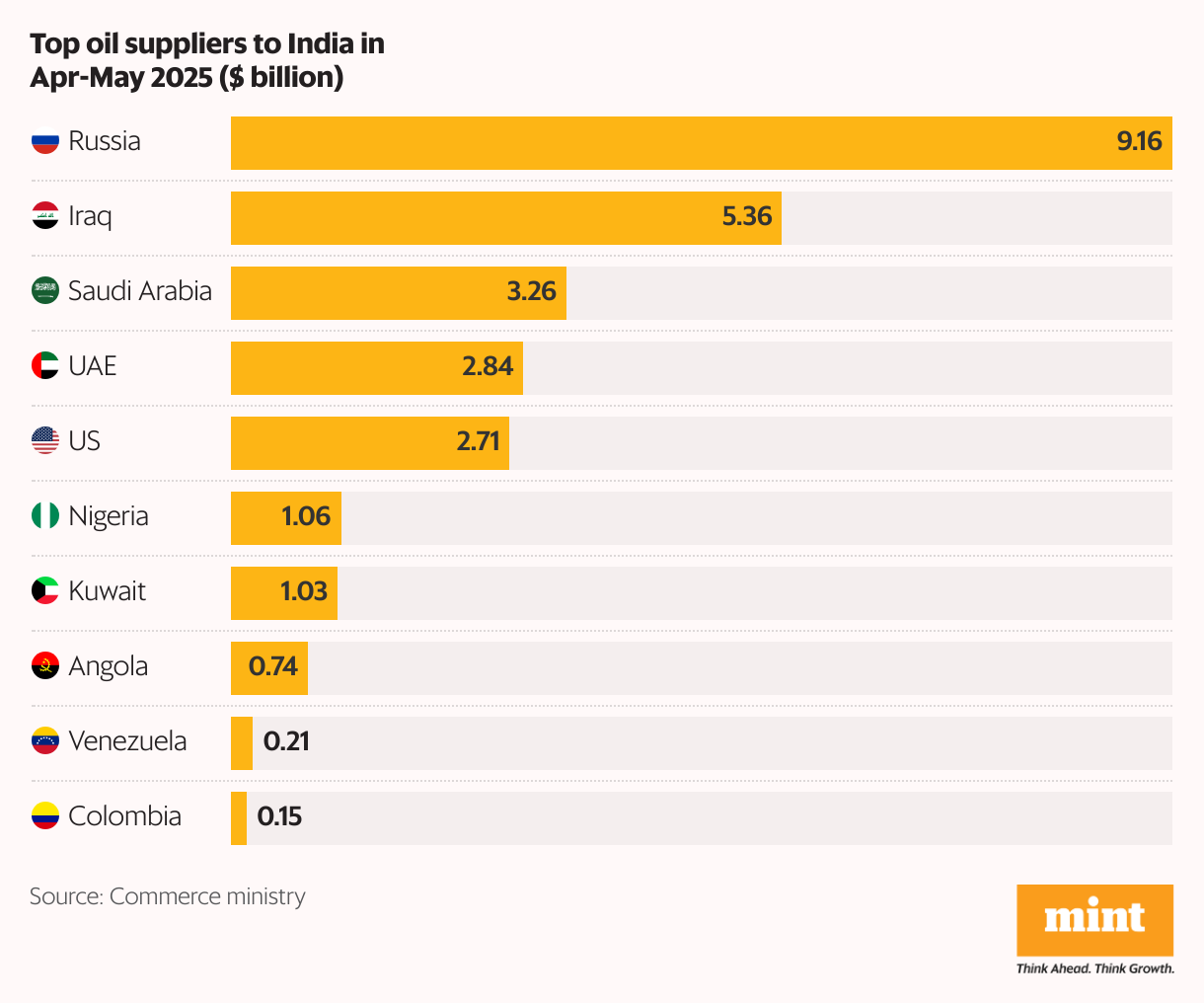
In FY25, Russia was India’s top supplier with oil worth $50.28 billion exported to India, followed by Iraq ($27.35 billion), Saudi Arabia ($20 billion) and the UAE ($13.86 billion). In the first two months of FY26, Russia supplied oil worth $9.16 billion, followed by Iraq ($5.36 billion), Saudi Arabia ($3.26 billion), UAE ($2.8 billion) and US ($2.7 billion.
“Inquiries for West Asian oil have already increased of late,” an industry executive said on condition of anonymity.
‘Suited for W. Asia’
Indian refiners are better equipped to handle Russian Urals and West Asian crude, the executive said, adding there is higher scope for more West Asian oil to flowing into India, compared to lighter variants such as West Texas Intermediate of the US. Apart from state-run refiners, Reliance Industries Ltd and Nayara Energy are also among India’s leading crude oil importers.
The person cited earlier said price may still be a concern for India. That is because West Asian suppliers do not generally offer discounts, and the final cost—which includes shipping, insurance and other costs—may be higher than the actual purchase price. Currently, the September contract of the benchmark Brent crude on the Intercontinental Exchange is trading at $66.64 per barrel.
Another industry participant said the Organization of the Petroleum Exporting Countries (Opec), which is led by Saudi Arabia along with the UAE and other West Asian countries, has a spare capacity of 5 million barrels per day and would be easily able to cater to the additional demand from India, the world’s third-largest energy importer.
New opportunity
“It may be an opportunity for India to reopen its oil requirements to suppliers across the globe. India does not necessarily need to look at only one or two options. Multiple countries may willingly compete to re-establish their supplies as a critical and ongoing share of India’s crude basket, and it could also help India in terms of supply terms and/or pricing—a potential win-win for all involved,” said Gaurav Moda, partner and leader for energy at EY, Parthenon India.
India and the US are at loggerheads over the import of Russian oil. US President Donald Trump has imposed 25% tariffs on India for buying Russian energy, taking the total duty to 50%. The additional tariffs are aimed at choking Russia’s oil revenues and forcing it to end the war in Ukraine. The new rate will take effect on 27 August.
India, however, has maintained that its imports are based on market factors along with the objective of ensuring energy security. In a statement on 6 August, the ministry of external affairs described the tariffs as “unfair, unjustified and unreasonable”.
Sanctions, curbs
On 2 August, Mint reported that India continues to buy oil from Russia notwithstanding the punishing penalty.
In 2022 and 2023, amid deep discounts being offered by Russia, Iraq also increased its supplies to India on the back of discounted oil.
India does not purchase oil from Iran and Venezuela, both of which face sanctions; however, there are no sanctions on Russian oil, and India continues to purchase it. However, the G7 nations have set a price cap of $60 per barrel on Russian oil. The European Union last month lowered the cap to about $47 per barrel from September. China and India are the top buyers of Russian oil.
Although the US and EU have raised concerns over India’s oil purchases from Russia, India has maintained that its energy procurement would depend on its needs. India imports over 88% of its crude oil requirement, and has diversified its oil sources to nearly 40 countries in order to ensure energy security.