





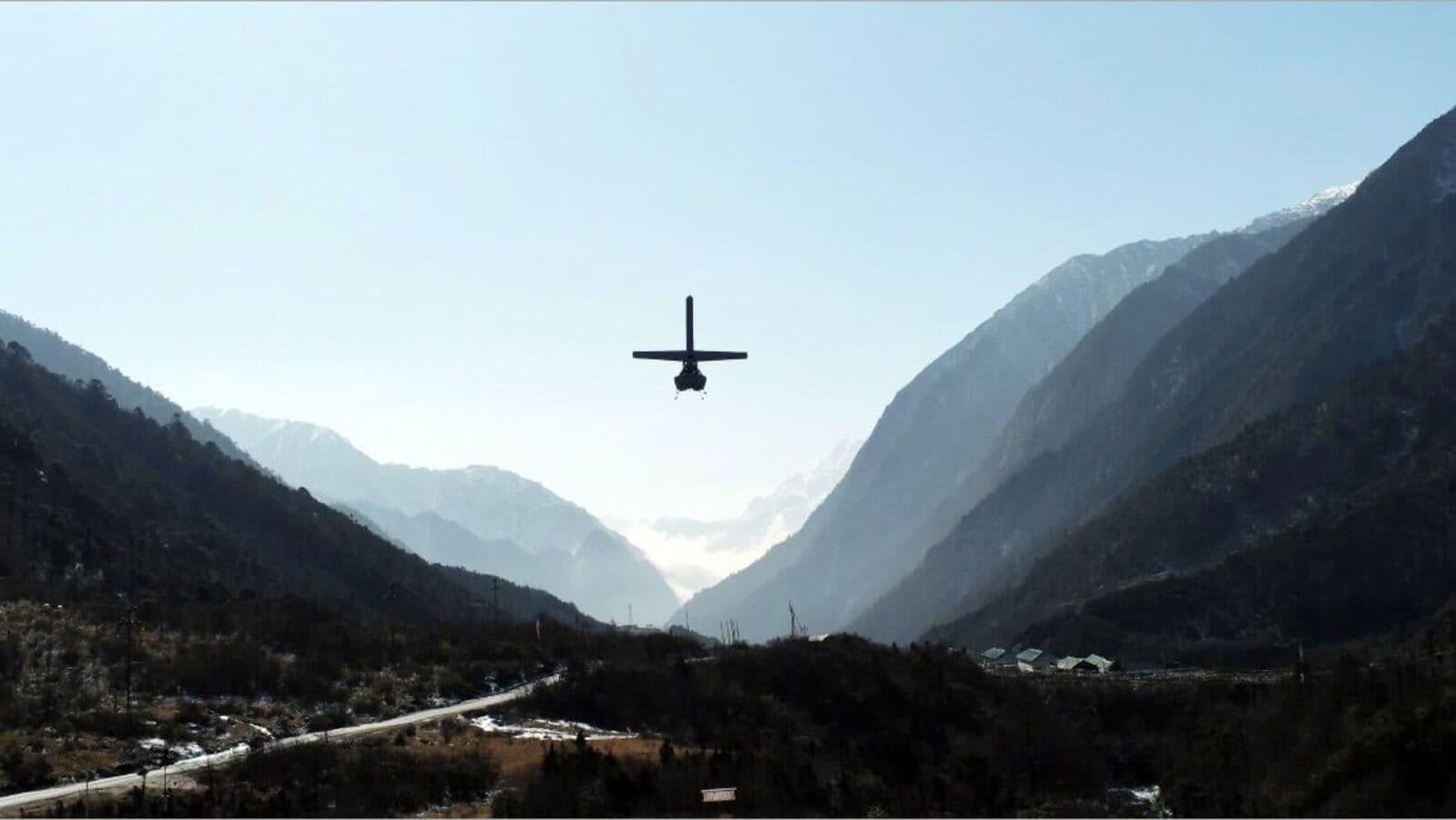
India is evaluating a combat drone deal with a built-in localisation blueprint—potentially marking a turning point in how the country procures and produces high-end military technology.
Under a $4.5-billion emergency procurement programme launched soon after Operation Sindoor, the defence ministry is in advanced talks with US-based Shield AI to import its V-Bat combat drones for the Indian Air Force—while also laying the groundwork for local manufacturing through a joint venture with JSW Defence, part of the multi-industry conglomerate JSW Group.
The initial deal with the Indian Air Force is set to be worth $35 million, which is the upper cap for a contract being signed under the emergency procurement programme. Meanwhile, JSW Defence and Shield AI have entered into a $90-million joint venture (JV) deal for transfer of the drone’s technology to JSW. This could later make for a larger contract for the JV from the Air Force in the long run, three people with direct knowledge of the matter told Mint.
The imported drones, once approved, can be sourced as early as the first half of the 2026 calendar year. Subsequently, locally manufactured V-Bat drones could start being produced from JSW Defence’s indigenous assembly line as early as the end of 2027.
The development not only marks the first instance of foreign defence technology being localised in India, but also mirrors a heightened sense of urgency in the country’s defence corridors to acquire cutting-edge technology for contactless warfare, which include drones, loitering munitions, ultra-high resolution and uninterrupted satellite surveillance, and more.
Shield AI’s V-Bat combat drones, which were used by Ukraine in its offensive against Russia last year, can operate even in non-GPS, network-jammed airspace regions, providing a key edge in modern warfare. These drones provide a level of sophistication and accuracy that cannot currently be matched by India’s indigenous drones made both by private firms such as IdeaForge and the Centre’s Defence Research and Development Organisation (DRDO).
Further, according to a senior executive close to the development, the company’s move to localize the drone in India with JSW Defence can help it operate outside the ambit of America’s restricted defence export controls—and cater to India, which is projected as a large defence market. The specifics of the deal are expected to be closed before the end of this calendar year.
Shield AI has already acquired security clearance from the US government to conduct the necessary transfer-of-technology arrangement that it is doing in India with JSW Defence, prior to signing the deal. This is significant since US defence suppliers need express clearance from Washington DC before it can offer its technologies to other geographies.
Emails sent to the ministry of defence and Shield AI did not receive responses until press time.
Urgent procurement plan
The Indian Air Force, Army and Navy will gain greater access to sophisticated global defence technology under an emergency procurement package cumulatively worth about $4.5 billion, which the defence ministry rolled out shortly after Operation Sindoor. The program is looking at multiple vendors, and is aimed at quickly addressing pain points in the country’s defence infrastructure.
“The early deals are meant just to give India early access to fill in gaps in national defence, through imports,” said a senior official requesting anonymity since the contracts are currently under evaluation. “Going forward, successful execution of the emergency procurement deals could lead to longer-term contracts.”
A second official aware of the matter said that other private defence contractors currently in talks include vendors from Israel, as well as Ukraine, but no other private contractor has as yet indicated interest towards technology transfer to India. “The most sophisticated technologies are right now not within the capabilities of Indian manufacturers, which necessitates us to procure cutting-edge weaponry from outside of India,” this official said.
Industry reactions
Industry stakeholders said such deals are of tantamount importance. “India is one of the world’s largest economies, and as we saw as part of the recent Operation Sindoor skirmish, non-contact warfare is a crucial aspect of future national security strategies,” said Sameer Patil, director of centre for security, strategy and technology at global think-tank Observer Research Foundation.
“India’s emergency procurement push involves both loitering munition and precision stand-off capabilities, which would expand its conventional warfighting capabilities without having to climb the nuclear escalation ladder,” Patil said. “In case of major previous threats to national security such as in 2008’s Mumbai attacks and 2016’s surgical strike following the Pulwama terrorist attack, the availability of cutting-edge drones and precision munitions is what India lacked.”
At the same time, India is also seeking access to uninterrupted satellite surveillance technologies as part of the same emergency procurement programme. While Indian firms are in the process of building indigenous versions of this technology, temporary sourcing could come from external suppliers such as vendors from the US, France and Israel, the first official added.
Such surveillance technology will require ultra-high-resolution satellites as well as low-latency transmissions for round-the-clock operations.
“India’s current surveillance satellite infrastructure is not sufficient to provide continuous surveillance because of the limited numbers. The gap is presently filled by taking imagery from foreign commercial companies,” said Anil Kumar Bhatt, director general of space industry body, Indian Space Association.
“India’s Space-Based Surveillance-3 (SBS-3) programme, under the Centre, is currently being implemented to bring such capabilities through 52 satellites, of which 31 will be supplied by the private sector,” he added.
For deeper capability building in defence technology, however, India needs to invest actively in research and development. The current emergency procurement contracts are not expected to come with indigenisation and technology transfer agreements.
The current spree of emergency procurement “underlines India’s need to invest in defence-led research and development, including incentivizing the private sector to spend more”, said Patil.
In the 2025-26 Union Budget, the government increased the allocation to the DRDO by 12% to $3.1 billion.